ARCHITECT SUCCESSES

SEE ALL
Coinme Acquired by Polygon Labs to Build its Open Money Stack

Transaction Overview
On January 13th, 2026, Polygon Labs announced it intends to acquire Coinme, a regulated crypto-as-a-service provider. Simultaneously, Polygon also announced the acquisition of Sequence, enabling payment flows across blockchain networks. Both acquisitions help build a fully integrated, rules-compliant stablecoin payments system – Poygon’s Open Money Stack.

Target: Coinme
Founded in 2014 and headquartered in Seattle, Coinme is a U.S.-regulated digital asset payments company offering crypto-as-a-service and stablecoin and crypto payment infrastructure for enterprises, fintechs, wallets, and payment applications.

Coinme is licensed and operates in 48 U.S. states, as well as Puerto Rico, and has built systems designed to handle fiat-to-crypto and stablecoin payments at scale while meeting U.S. regulatory requirements.

Coinme provides capabilities that partners integrate into their products. These capabilities, delivered as a set of APIs or SDKs, include KYC, payments by debit card, bank transfer, or cash, converting between fiat and crypto, trading, and custody, so partners can offer end-to-end crypto and stablecoin features embedded in their own applications.

Coinme also supports a large cash-to-crypto network through partnerships, providing the software and compliance layer that enables cash on-ramps and off-ramps at 50,000+ locations across the U.S.

Coinme serves more than one million users and has processed more than $1.3 billion in total transactions since it launched. Its enterprise customers include Coinstar, Exodus, Mercuryo, Baanx, and Breeze.

Coinme was co-founded by CEO Neil Bergquist and has raised $41M in equity funding from Pantera, Digital Currency Group, Coinstar, Circle, and MoneyGram.

Coinme competitors include: ZeroHash, MoonPay, Bridge | Stripe, Banxa | OSL, and Paxos.

Buyer: Polygon Labs
Polygon was founded in 2017 as Matic Network and is actively undergoing an evolution in its product offering. Polygon Labs, formed in 2023, is responsible for supporting the development of the Polygon ecosystem, with a focus on fast, low-cost blockchain infrastructure for payments.

Polygon is now building the Open Money Stack, an integrated set of services designed to move money instantly and reliably, globally. It combines blockchain settlement on the Polygon network with core payment components like wallets, stablecoin integrations, cross-chain connectivity, and compliance tooling, to keep funds on-chain so they can be used across on-chain financial applications.

To make this work across many different blockchains, Polygon Labs is building AggLayer, a settlement layer meant to help different blockchains connect and exchange value with each other quickly and at low cost, reducing the need for separate, disconnected systems.

Polygon is a listed token with a current fully diluted value of $1.6B. Polygonscan shows more than 6.2 billion total transactions on Polygon. Polygon’s website also points to scale indicators like billions of dollars of stablecoins on the network, millions of transactions per day on average, and monthly payment volume, and describes Polygon as infrastructure that can support “trillions” of value moving through it.

The company was co-founded by Jaynti Kanani, Sandeep Nailwal, Mihailo Bjelic, and Anurag Arjun, and is currently led by CEO Marc Boiron, who was appointed in 2023.

Historically, in 2021, Polygon acquired zero-knowledge cryptography companies Mir and Hermez for $400M and $250M, respectively, but these are no longer aligned with the company’s Open Money Stack vision.

Transaction Parameters
Polygon Labs is acquiring Coinme for an undisclosed amount. In combination with another acquisition, Sequence, simultaneously announced by Polygon today. The combined acquisition value is around $250M. This marks one of the first examples of a protocol acquiring an operating business. The Coinme transaction is expected to close in Q2 2026.

Architect Partners served as the exclusive financial advisor to Coinme.

Notable comparable transactions include OSL | Banxa for $62M (M&A Alert), Nuvei | Simplex for $250M (M&A Alert), Ripple | Rail for $200M (M&A Alert), Stripe | Bridge for $1.1B (M&A Alert), MoonPay | Iron for $100M (M&A Alert), and MoonPay | Helio for $175M (M&A Alert).

Strategic Rationale
Polygon is acquiring Coinme and Sequence to move from being a settlement rail to owning the full experience of how money comes on-chain, moves on-chain, and settles back into the real world. The combination of Coinme’s licensed payments offering with Sequence’s wallet and payments orchestration stack gives Polygon an end‑to‑end, regulated crypto payments platform that spans physical kiosks, embedded wallets, and cross‑chain routing.

On Day 1, Polygon can take this integrated “crypto‑as‑a‑service” solution to banks, PSPs, neobanks, and fintechs who want compliant, turnkey stablecoin and token payments without building their own licensing, infrastructure, or user experience.

Architect Partners’ Observations
This acquisition(s) underscores a broader inflection point in the blockchain protocol market: technological performance and scalability alone will not win. The integration of real-world rails and the ability to deliver end-to-end value for mainstream users are becoming table stakes. As the market matures, competitive advantage is shifting toward owning the commercialization layer, including regulated fiat access, compliance operations, distribution channels, partner integrations, and strong product integration.

Networks that rely entirely on third-party providers risk commoditization, margin leakage, inconsistent user experience, and strategic dependency, just as stablecoins and tokenized products begin to drive meaningful transaction volume and the corresponding revenue opportunities.
Polygon’s actions show they fully understand the importance of this approach.

Sources
Polygon Press Release
Architect Partner M&A Tracker
PitchBook

Insights

Week of March 03 – March 09

Todd White
March 12, 2025
DOWNLOAD FULL REPORT

March 03 – March 09 (Published March 12th)

PERSPECTIVES by Todd White


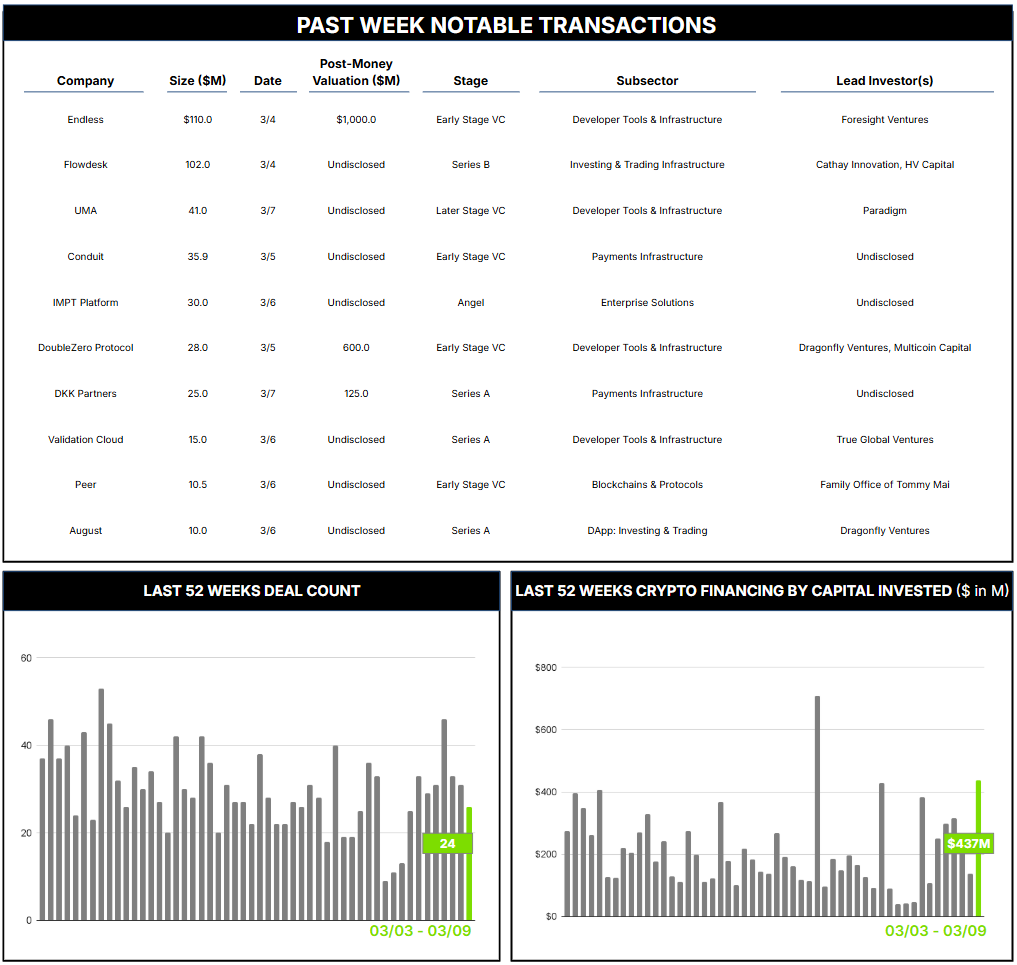
26 Crypto Private Financings Raised: $437.1M

Rolling 3-Month-Average: $197.5M

Rolling 52-Week Average: $211.6M


We believe four foundational factors are useful signals for assessing the innovation and maturation of emerging technologies: capital invested, number of users, value created, and corporate strategy enacted through M&A. In our “Family Ties” series, first published in January 2024 (here) and updated last month (here), we use these factors to compare the Internet and Crypto to reveal some striking conclusions. For example, we found that in 2024, the value created in the Crypto sector surpassed that of the Internet at the same stage in its respective life cycle—an exciting and potentially “breakout” moment for investors.


However, other factors continue to lag, most notably the number of users. There are, of course, myriad causes for this dearth of “useful things” beyond pure speculation. But the difficulty in transitioning practical everyday applications from Web2 to Web3 is likely high on anyone’s list.


The truth is that Crypto and blockchain present businesses with a thorny mix of technical, regulatory, and user-centric challenges to adoption. Chief among them is the sheer complexity of blockchain and dApps, which often requires specialized expertise and a steep learning curve, with both time and financial investments that can exceed the means of many businesses. Technical limitations, such as slower processing speeds and high transaction cost, also constrain scalability and adoption.


Regulatory uncertainty, particularly in the U.S., has created (unnecessary?) compliance risks and strategic hesitancy. While this may now be changing, the need to navigate unclear legal frameworks has complicated long-term business planning and adoption. The lack of intuitive user interfaces, closely tied to the technical challenges above, remains a persistent hindrance. The need to manage wallets, transaction fees, and blockchain interactions must be simplified to drive broader acceptance among non-technical users. Interoperability across chains and integration with legacy Web2 systems is another persistent challenge. The risk of disrupting critical workflows can incite caution and even fear of destabilizing core models for early movers seeking to adopt untested Web3 strategies.


Endless is a cloud-based protocol designed to simplify the transition to the Web3 world of decentralized blockchain technologies. Their platform combines essential Web3 components, such as blockchain networks, data storage, and messaging, with an AI agent toolchain and a simplified interface tailored for developers familiar with traditional web programming. Their goal is to accelerate adoption by lowering the technical barriers to entry for mainstream developers and businesses, with a system designed to handle large numbers of transactions quickly and at low cost.


Our analysis suggests this work is sorely needed. And investors seem to agree, supporting Endless this week with a $110 million funding round at a $1 billion project valuation. Now let us see if that elusive cohort of inchoate Web3 users agrees.


Contact ryan@architectpartners.com to schedule a meeting.