Stablecoins are starting to look like the settlement medium for a new kind of programmable financial infrastructure, one built around software rather than humans. AI agents are the clearest near-term example. Traditional payment rails assume a person somewhere in the loop: card entry, invoices, approvals, wires, batch windows, business hours. Autonomous software needs something different. It needs settlement in seconds, transactions worth a fraction of a cent, wallets that can enforce spending limits and compliance rules on their own, and an audit trail by default. Stablecoins fit because most of those properties come from the blockchain underneath, not from the dollar itself. Settlement is final in seconds. Smart contracts enforce policy without an intermediary. Low-fee chains like Base and Solana make sub-cent transactions economically viable. The ledger never closes and is auditable by default.
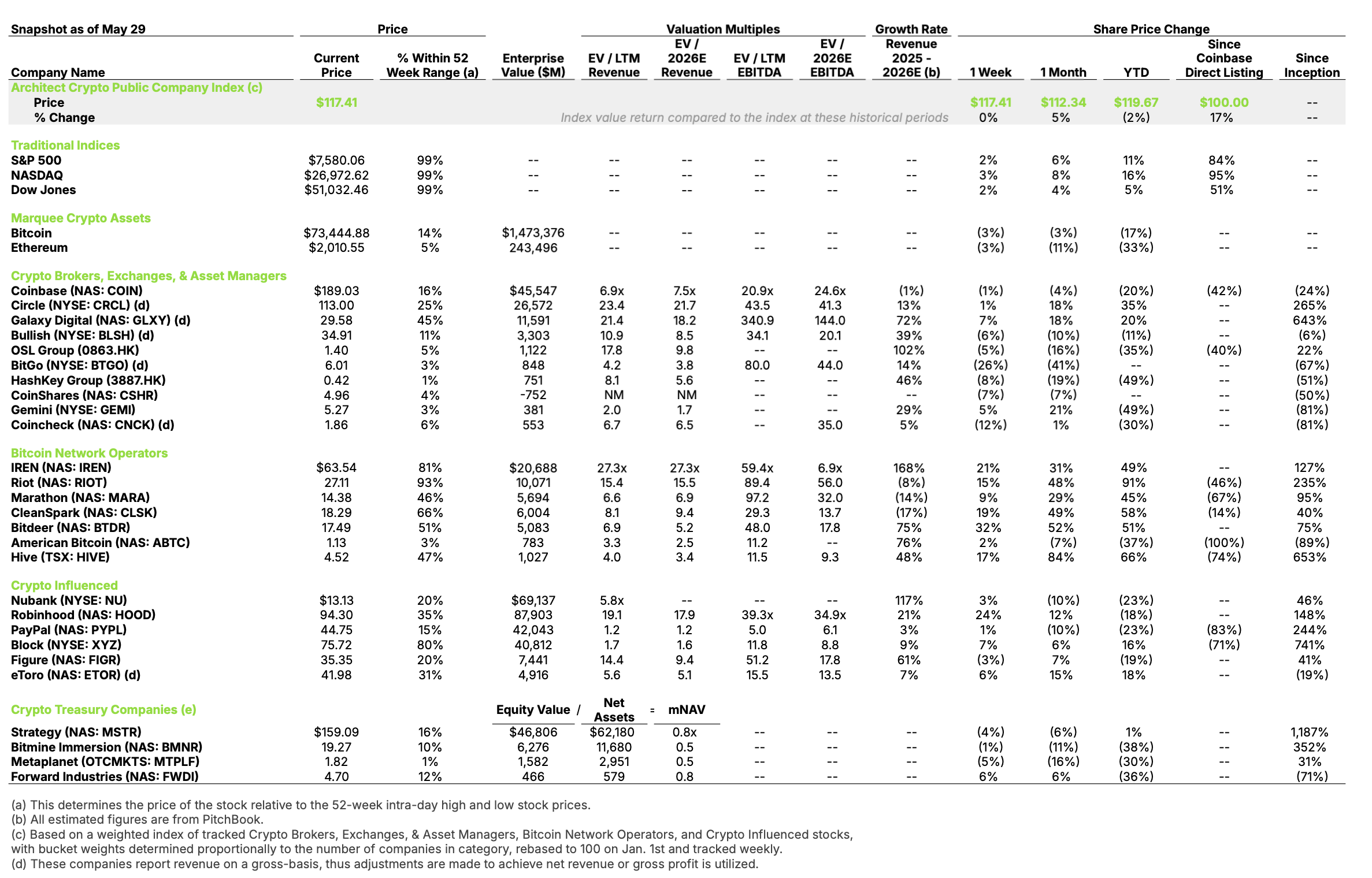
Two public-market companies are already executing the shift from complementary angles. Circle is approaching it from the issuer side. On May 11, Circle announced Agent Stack, positioning USDC as the settlement layer for AI agents by pairing agent wallets and policy controls with nanopayments through Circle Gateway, including gas-free transfers as small as $0.000001. The design only makes sense if the primary user is software; sub-cent, gas-free transfers are not features human users need, they only become useful at machine velocity. Circle is the only public-market stablecoin issuer building an explicit AI-native stack at scale, which positions USDC as the leading issuer-side candidate as the agent economy develops.
Coinbase is approaching the same opportunity from the developer side. On May 7, Coinbase and AWS announced Amazon Bedrock AgentCore Payments, integrating Coinbase’s x402 discovery protocol and wallet infrastructure now sit inside Amazon Bedrock AgentCore Payments, letting AWS developers build agents that find services, pay in tiny amounts and settle instantly in USDC on Base or Solana. What matters here is distribution: most blockchain payments infrastructure has lacked a real channel to mainstream developers, and the Bedrock integration puts Coinbase’s stack in front of where agents are actually being built. Combined with ownership of Base and the wallet layer, the result is the closest thing in public markets to a full-stack AI-native payments platform. Between Circle and Coinbase, the operating layer for agent settlement is increasingly being built and owned inside public crypto companies.
The regulatory side is starting to move too. On May 11th, Augustus, still private, has received preliminary conditional OCC approval for a branchless national bank focused on stablecoin and AI-native clearing. It is an early signal that this kind of architecture is being taken seriously inside the regulated banking perimeter.
The bigger point is that the next phase of stablecoins is less about faster dollar rails and more about being embedded directly into software workflows. For public crypto companies, the prize is not just issuing stablecoins or facilitating stablecoin trading. It is owning the infrastructure that lets software discover services, pay, settle and enforce controls on its own. If AI agents become real economic actors, stablecoins are likely to be one of their primary settlement assets.