SpaceX’s $75B IPO is historic in scale, surpassing Saudi Aramco’s 2019 listing and becoming the largest IPO ever. But the more important signal is what it represents: the first major public-market event in a potential wave of category-defining AI IPOs. SpaceX brings one of the most ambitious AI infrastructure stories to market, with Anthropic and OpenAI also moving toward public listings. In effect, public investors are being asked to underwrite not just another growth company, but a new class of AI-linked mega-cap issuers that could absorb extraordinary amounts of global risk capital.
That matters for crypto because AI has become the dominant gravitational force across both private and public markets. In 2025, AI companies captured 61% of global venture investment, or $258.7B of $427.1B total VC dollars. A similar crowding-out dynamic appears to be emerging in public markets. The IPO window is open, but it is increasingly selective. Investors are not abandoning growth. They are reallocating growth capital toward the largest and most institutionally sponsored AI-linked opportunities.
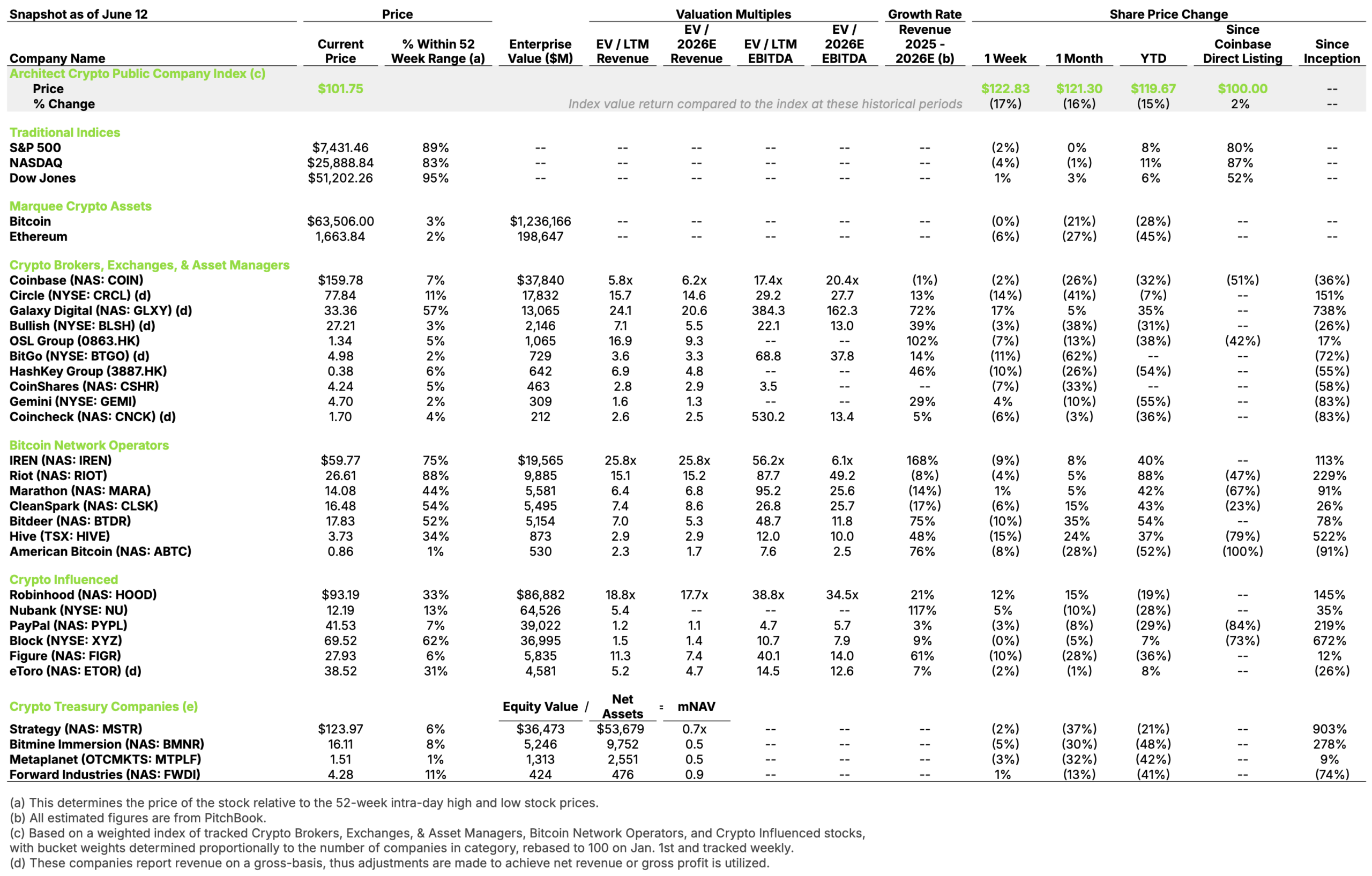
Crypto is feeling that pressure directly. Kraken, Ledger, Consensys, and Grayscale have all reportedly paused or pushed back IPO plans this year, while BitGo remains the only major crypto-native IPO to price so far. This does not mean the long-term crypto infrastructure thesis has disappeared. Stablecoins, tokenization, custody, and regulated market structure remain among the most important themes in financial technology. The issue is that crypto equities still trade like higher-beta, more reflexive risk assets, often closely tied to token-market sentiment.
Bitcoin’s recent weakness reinforces the point. It is difficult to prove that investors are selling bitcoin specifically to fund AI IPO participation, but the broader rotation is visible. Reuters recently reported heavy bitcoin ETF outflows alongside significant inflows into semiconductor ETFs, a clear indication that investors are prioritizing AI-linked exposure over crypto beta.
The conclusion is not that crypto’s public-market window is closed. It is that the opportunity cost of owning crypto equities has risen. In a year defined by SpaceX, Anthropic, and OpenAI, crypto issuers need either a better window, a cleaner story, or a clearer reason to be owned alongside AI rather than after it.