ARCHITECT SUCCESSES

SEE ALL
Payward Acquires Magic Labs Embedded Wallet Business

Transaction Overview
On July 27, 2026, Payward, the B2B crypto infrastructure parent behind the crypto exchange Kraken, announced a definitive agreement to acquire wallet-as-a-service business Magic Labs. Financial terms of the transaction were not disclosed.

Target: Magic Labs (Wallet Infrastructure)
Founded in 2018 and headquartered in San Francisco, Magic Labs is a wallet-as-a-service infrastructure provider that enables businesses to create non-custodial embedded wallets for their end users. The company was co-founded by Sean Li, Arthur Jen, and Jaemin Jin.

Magic’s core offering is a developer-facing SDK and API that provides embedded wallets with passwordless authentication via email, social login, passkeys, or SSO. The product suite includes 1) API Wallets for server-side management with security and customizable key sharding, and 2) Embedded Wallets for client-side non-custodial key management. As of July 2026, the platform supports more than 30 blockchain networks and provides a white-label UI, fiat onramps, and transaction signing.

As of July 2026, Magic Labs had provisioned more than 60 million wallets and served more than 200,000 developers across more than 18,000 applications. Clients include Polymarket, Naver, Helium, Forbes, WalletConnect, Mattel, and Immutable. During the 2024 U.S. presidential election, Polymarket processed over $3 billion in prediction market transactions with zero downtime, powered by Magic’s embedded wallets. Magic said it had supported over $8.9 billion in cumulative transaction volume for Polymarket as of November 2025.

Magic Labs has raised a total of $83 million in disclosed venture funding across 4 rounds, with significant investors including PayPal Ventures, Northzone, Tiger Global, Digital Currency Group, CoinFund, and Placeholder VC.

In November 2024, Magic Labs announced Newton, a chain unification network built in collaboration with Polygon Labs, expanding beyond wallet infrastructure into cross-chain protocol development. In November 2025, Magic Labs integrated the Newton Protocol SDK across its developer network. The company described Newton Protocol as “the authorization layer for on-chain finance.” These moves preceded the company’s decision to divest its wallet business and refocus entirely on protocol development.

Buyer: Payward
Founded in 2011 and headquartered in San Francisco, Payward is a private B2B crypto infrastructure holding company. Payward operates Kraken, one of the longest-running cryptocurrency exchanges, alongside NinjaTrader, xStocks, Bitnomial, and CF Benchmarks. The company is led by co-CEOs Arjun Sethi and Dave Ripley.

Most relevant to this transaction, Payward operates Payward Services, a B2B infrastructure platform that provides institutions with access to Payward’s trading, custody, settlement, and payments infrastructure via API. The acquisition of Magic Labs adds embedded wallet infrastructure to their offering. In April 2026, Payward launched a white-label fiat-to-crypto onramp through a partnership with Onramper, making embedded wallet infrastructure a natural adjacent capability.

Payward has been expanding beyond its core exchange through acquisition. In 2025, the company acquired NinjaTrader for $1.5 billion (retail futures, M&A Alert) and agreed to acquire Backed Finance (tokenized equities, Press). In 2026, it acquired Magna (token lifecycle management, Press), completed the acquisition of Bitnomial for up to $550 million (regulated derivatives, M&A Alert), and agreed to acquire Reap for $600 million (card issuance and payments, M&A Alert). Including this transaction, Payward has announced or completed 8 acquisitions since early 2025, committing several billion dollars to platform expansion ahead of its planned public listing.

For the full year of 2025, Payward reported adjusted revenue of $2.2 billion, a 33% increase year over year from $1.5 billion in 2024. Trading-based revenue accounted for 47% of the total, with the remaining 53% from asset-based services, including payments, custody, yield, and financing.

In November 2025, Payward raised $800 million at a $20 billion post-money valuation in a round backed by Citadel Securities, Jane Street, and Apollo Global Management, and confidentially filed an S-1 with the SEC ahead of a planned IPO. In April 2026, Deutsche Börse Group made an additional $200 million strategic investment in the company.

Transaction Parameters
Payward has signed a definitive agreement to acquire the wallet-as-a-service business of Magic Labs for an undisclosed amount. The transaction includes Magic Labs’ embedded wallet business, including wallet clients and associated infrastructure.

The transaction is part of a broader corporate restructuring in which Magic Labs is rebranding as Newton Labs to focus on the Newton Protocol. The two companies will remain independent following the close.

Architect Partners served as the exclusive financial advisor to Magic Labs.

Strategic Rationale
Payward is acquiring Magic’s embedded wallet business to augment Payward Services’ B2B offering. Payward Services gives partners a single integration point for trading, custody, tokenized assets, on/off-ramps, and derivatives. The wallet, the account layer where end users actually hold assets and interact with onchain products, was a critical piece partners still had to source from a third party. Magic brings that layer in-house with proven infrastructure: a TEE-based signing solution, an embedded integration layer, and a developer SDK that together have provisioned more than 60 million wallets and supported over $10 billion in stablecoin volume for 200,000+ developers.

On Day 1, Payward can offer fintechs, enterprises, and financial institutions a complete embedded onchain offering under a single provider, spanning wallet provisioning, onboarding, funding, trading, custody, and settlement, without stitching together multiple vendors. Every embedded wallet also becomes a distribution point that routes transaction volume into the rest of Payward’s infrastructure, deepening the non-trading, less volatile revenue that already accounts for 53% of Payward’s total as it heads toward a public listing.

Architect Partners’ Observations
This transaction marks the near-completion of a consolidation wave in embedded wallet infrastructure. In roughly one year, Fireblocks acquired Dynamics ($90M), Consensys acquired Web3Auth ($50M), Stripe acquired Privvy, Ripple acquired Palisade, and Paxos acquired Fordefi. Now each group has its own independent wallet infrastructure provider, and Payward has acquired the category’s pioneer. The market has reached a clear verdict: embedded wallets are foundational infrastructure for every onchain product, and they are a layer of a full-stack platform rather than a standalone business.

The logic is simple: the wallet is becoming the account primitive of onchain finance. Whoever provisions the wallet sits at the front of the customer relationship and routes the volume that follows. For platforms whose trading revenue is inherently cyclical, owning the onboarding layer converts market position into durable, recurring B2B infrastructure revenue.

Sources
Press Release, Payward Services, PitchBook

Crypto Public Companies Snapshot

Crypto Public Companies Snapshot

Glenn Gottlieb
January 19, 2023
DOWNLOAD FULL REPORT

News on Macro Economic Data


There wasn’t much economic news this past week.   The economic picture shows signs of improvement, but also persistent headwinds.   Recession fears are receding, as a survey of economists believe the likelihood of a recession in 2024 is only 42%, but only project a 1.6% growth rate. 


Jamie Dimon, CEO of JP Morgan, made news by suggesting he is “…a little skeptical of this kind of Goldilocks scenario.  I still think the chances of it not being a soft landing are higher than other people”.    The Conference Board also believes it is more probable that the US will slip into a short and shallow recession than not in 2024.


San Francisco Fed President and voting member today said that inflation is not down to 2%, there is a lot of work left to do, and suggested it’s too early to suggest rate changes are around the corner.  


Crypto Public Company Activity


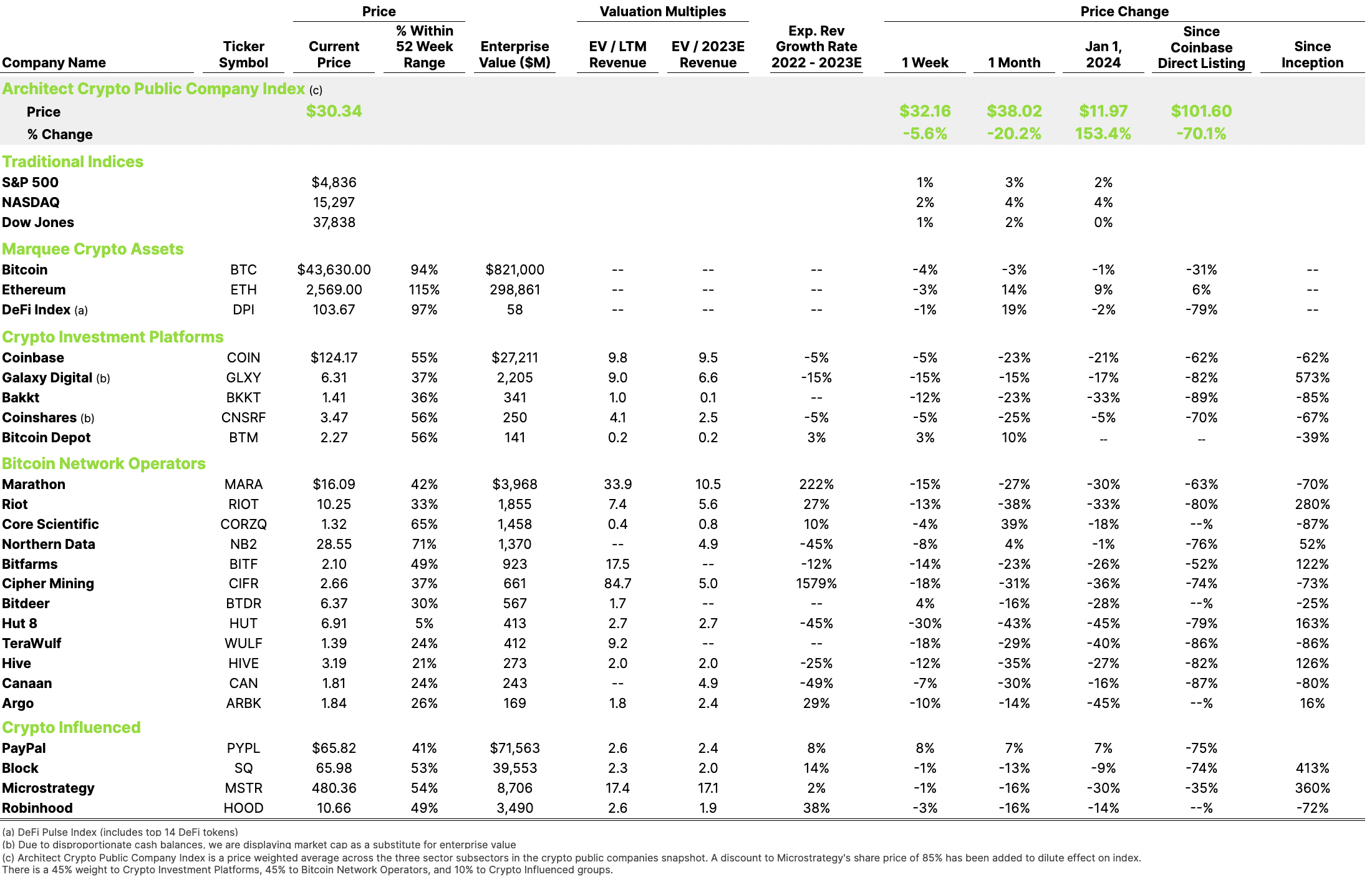
Stock in the top 12 Bitcoin miners fell sharply this week and are down about $6B in market capitalization since January 1 according to TheMinerMag.   This drop is certainly the result of a confluence of factors rather than a singular event.  A few possible catalysts include:


  1. Miner revenue does fluctuate, but the trend line has been declining in recent weeks.  Total fees have fallen over the past 30 days from ~$60M per day to ~$40M per day according to YCharts


  1. The Expected April Bitcoin halving will reduce mining rewards in half which investors could believe will adversely affect profitability and negatively impact stock prices


  1. Bitcoin ETFs enable a direct, efficient, and liquid investment in Bitcoin that may be reallocating funds away from mining stocks.   It would be a justifiable rotation to reallocate profits from the Q4 2023 runup in mining stocks to the current increasing value of Bitcoin


  1. Negative news within a sector generally has a corresponding negative effect on an entire sector.  Hut8 fell 20% on Thursday alone, as unverified reports emerged of financial misbehavior regarding its recent $742M merger with US Bitcoin Corp.  The allegation came from J Capital Research – a short seller of Hut8 stock


The world of crypto mining is complex, and this short-term move is worth keeping an eye on.  Like any risk asset, there are always both positive and negative movements.   And, in the volatile world of crypto, all investments carry above-average risk and deserve deep diligence.