ARCHITECT SUCCESSES

SEE ALL
Payward Acquires Magic Labs Embedded Wallet Business

Transaction Overview
On July 27, 2026, Payward, the B2B crypto infrastructure parent behind the crypto exchange Kraken, announced a definitive agreement to acquire wallet-as-a-service business Magic Labs. Financial terms of the transaction were not disclosed.

Target: Magic Labs (Wallet Infrastructure)
Founded in 2018 and headquartered in San Francisco, Magic Labs is a wallet-as-a-service infrastructure provider that enables businesses to create non-custodial embedded wallets for their end users. The company was co-founded by Sean Li, Arthur Jen, and Jaemin Jin.

Magic’s core offering is a developer-facing SDK and API that provides embedded wallets with passwordless authentication via email, social login, passkeys, or SSO. The product suite includes 1) API Wallets for server-side management with security and customizable key sharding, and 2) Embedded Wallets for client-side non-custodial key management. As of July 2026, the platform supports more than 30 blockchain networks and provides a white-label UI, fiat onramps, and transaction signing.

As of July 2026, Magic Labs had provisioned more than 60 million wallets and served more than 200,000 developers across more than 18,000 applications. Clients include Polymarket, Naver, Helium, Forbes, WalletConnect, Mattel, and Immutable. During the 2024 U.S. presidential election, Polymarket processed over $3 billion in prediction market transactions with zero downtime, powered by Magic’s embedded wallets. Magic said it had supported over $8.9 billion in cumulative transaction volume for Polymarket as of November 2025.

Magic Labs has raised a total of $83 million in disclosed venture funding across 4 rounds, with significant investors including PayPal Ventures, Northzone, Tiger Global, Digital Currency Group, CoinFund, and Placeholder VC.

In November 2024, Magic Labs announced Newton, a chain unification network built in collaboration with Polygon Labs, expanding beyond wallet infrastructure into cross-chain protocol development. In November 2025, Magic Labs integrated the Newton Protocol SDK across its developer network. The company described Newton Protocol as “the authorization layer for on-chain finance.” These moves preceded the company’s decision to divest its wallet business and refocus entirely on protocol development.

Buyer: Payward
Founded in 2011 and headquartered in San Francisco, Payward is a private B2B crypto infrastructure holding company. Payward operates Kraken, one of the longest-running cryptocurrency exchanges, alongside NinjaTrader, xStocks, Bitnomial, and CF Benchmarks. The company is led by co-CEOs Arjun Sethi and Dave Ripley.

Most relevant to this transaction, Payward operates Payward Services, a B2B infrastructure platform that provides institutions with access to Payward’s trading, custody, settlement, and payments infrastructure via API. The acquisition of Magic Labs adds embedded wallet infrastructure to their offering. In April 2026, Payward launched a white-label fiat-to-crypto onramp through a partnership with Onramper, making embedded wallet infrastructure a natural adjacent capability.

Payward has been expanding beyond its core exchange through acquisition. In 2025, the company acquired NinjaTrader for $1.5 billion (retail futures, M&A Alert) and agreed to acquire Backed Finance (tokenized equities, Press). In 2026, it acquired Magna (token lifecycle management, Press), completed the acquisition of Bitnomial for up to $550 million (regulated derivatives, M&A Alert), and agreed to acquire Reap for $600 million (card issuance and payments, M&A Alert). Including this transaction, Payward has announced or completed 8 acquisitions since early 2025, committing several billion dollars to platform expansion ahead of its planned public listing.

For the full year of 2025, Payward reported adjusted revenue of $2.2 billion, a 33% increase year over year from $1.5 billion in 2024. Trading-based revenue accounted for 47% of the total, with the remaining 53% from asset-based services, including payments, custody, yield, and financing.

In November 2025, Payward raised $800 million at a $20 billion post-money valuation in a round backed by Citadel Securities, Jane Street, and Apollo Global Management, and confidentially filed an S-1 with the SEC ahead of a planned IPO. In April 2026, Deutsche Börse Group made an additional $200 million strategic investment in the company.

Transaction Parameters
Payward has signed a definitive agreement to acquire the wallet-as-a-service business of Magic Labs for an undisclosed amount. The transaction includes Magic Labs’ embedded wallet business, including wallet clients and associated infrastructure.

The transaction is part of a broader corporate restructuring in which Magic Labs is rebranding as Newton Labs to focus on the Newton Protocol. The two companies will remain independent following the close.

Architect Partners served as the exclusive financial advisor to Magic Labs.

Strategic Rationale
Payward is acquiring Magic’s embedded wallet business to augment Payward Services’ B2B offering. Payward Services gives partners a single integration point for trading, custody, tokenized assets, on/off-ramps, and derivatives. The wallet, the account layer where end users actually hold assets and interact with onchain products, was a critical piece partners still had to source from a third party. Magic brings that layer in-house with proven infrastructure: a TEE-based signing solution, an embedded integration layer, and a developer SDK that together have provisioned more than 60 million wallets and supported over $10 billion in stablecoin volume for 200,000+ developers.

On Day 1, Payward can offer fintechs, enterprises, and financial institutions a complete embedded onchain offering under a single provider, spanning wallet provisioning, onboarding, funding, trading, custody, and settlement, without stitching together multiple vendors. Every embedded wallet also becomes a distribution point that routes transaction volume into the rest of Payward’s infrastructure, deepening the non-trading, less volatile revenue that already accounts for 53% of Payward’s total as it heads toward a public listing.

Architect Partners’ Observations
This transaction marks the near-completion of a consolidation wave in embedded wallet infrastructure. In roughly one year, Fireblocks acquired Dynamics ($90M), Consensys acquired Web3Auth ($50M), Stripe acquired Privvy, Ripple acquired Palisade, and Paxos acquired Fordefi. Now each group has its own independent wallet infrastructure provider, and Payward has acquired the category’s pioneer. The market has reached a clear verdict: embedded wallets are foundational infrastructure for every onchain product, and they are a layer of a full-stack platform rather than a standalone business.

The logic is simple: the wallet is becoming the account primitive of onchain finance. Whoever provisions the wallet sits at the front of the customer relationship and routes the volume that follows. For platforms whose trading revenue is inherently cyclical, owning the onboarding layer converts market position into durable, recurring B2B infrastructure revenue.

Sources
Press Release, Payward Services, PitchBook

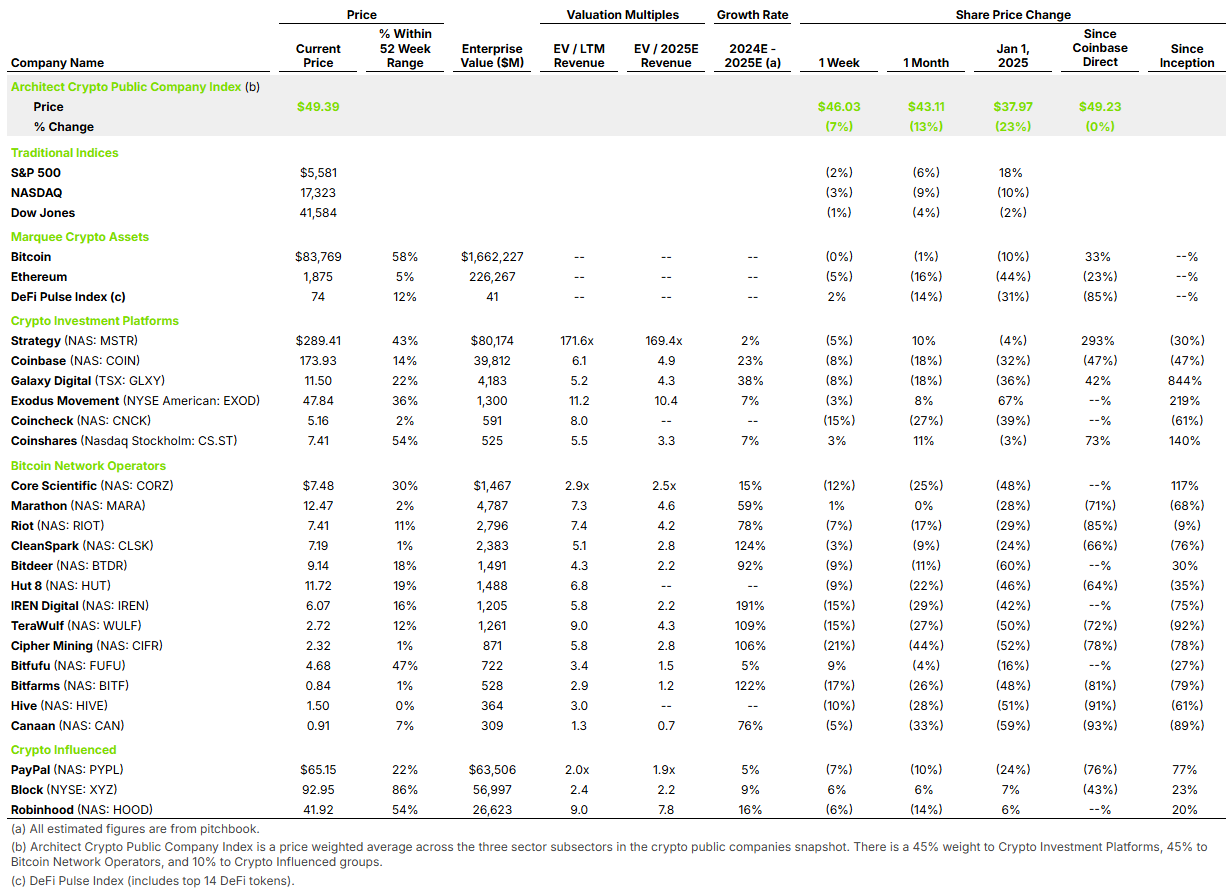
Crypto Public Companies Snapshot

Crypto Public Companies Snapshot

Elliot Chun
March 28, 2025
DOWNLOAD FULL REPORT

BTC as a treasury reserve asset on the balance sheet of publicly traded companies is still an unproven strategy and a relatively new concept.


The primary theses for holding BTC as a treasury reserve asset are that BTC serves as a hedge against fiat (specifically USD) inflation and offers a tool for treasury diversification and risk management.


Naysayers of this strategy argue: if gold isn’t held as a treasury asset on the balance sheets of publicly traded companies today, then why would they hold BTC? The challenge lies in how gold is owned—either physically or via futures. While gold is a commodity, physical gold must be stored, is not easily moved, and may not be fungible with other physical bars. Gold futures are classified as securities and cannot appear on a balance sheet as a treasury reserve asset. BTC, on the other hand, is a digital commodity that is GAAP-recognized as a tangible asset with a fungible and liquid profile.


The pioneer of this strategy, MicroStrategy (MSTR), first announced BTC as its “primary treasury reserve asset” on August 20, 2020. MicroStrategy had three additional theses for implementing this tactic:


Access → MSTR provided institutional investors with exposure to BTC as an asset class, since the vast majority of asset managers could not directly own BTC.


Asymmetric Upside → MSTR CEO Michael Saylor is known, among other things, for his “Triple Bitcoin Maxi”-type language espousing BTC’s long-term price appreciation.


Branding as the Bitcoin Innovator → MSTR became the first BTC “meme stock,” riding a wave of attention and brand differentiation.


The results are hard to dispute when looking at price performance from August 20, 2020, to March 28, 2025: S&P 500: +64.81%, BTC: +781.13%, MSTR: +2,074.85%


This week, original meme stock GameStop (GME) announced a $1.3B convertible note to implement the BTC treasury reserve asset strategy. The CEO stated: “We believe GameStop has an incredible opportunity to transform its financial future by becoming the premier bitcoin treasury company in the gaming sector.” With BTC volatility proving to be a double-edged sword, GME has traded down over 20% since the announcement.


So how many publicly traded companies are executing this strategy today? According to bitcointreasuries.net, the number stands at 89. With GameStop, that makes 90. Granted, the vast majority of these are not bellwethers or household names, but I suspect 90 is far more than most would have expected.


We attended last month’s Bitcoin Investor Week in NYC, there was an entire day dedicated to educating publicly traded companies on this tactic. Last year, MSTR hosted a full conference in Las Vegas.


Like most new concepts—especially those in crypto—I ask the question: Are we going to see more or less of this activity? Until my answer is “less,” I’ll continue to pound the table on the adoption of these strategies.


That said, there’s a massive difference between truly using BTC for treasury diversification and risk management purposes versus pivoting a company’s entire operating thesis to become the “premier bitcoin treasury company” for any given sector. Companies who are implementing this strategy in hopes of replicating MSTR’s performance are positioning for disappointment. MSTR is one-of-one, similar to Tether and its stablecoin dominance. With access to BTC through ETFs, these companies cannot provide the same access, asymmetric upside or innovation branding that MSTR does.


Across all the different strategies and implementations, I anticipate that by 2030, a quarter of the S&P 500 will have BTC somewhere on their balance sheets as a long-term asset.


Why? Because those managing treasury assets won’t be able to say they didn’t at least try. If you tried it and it worked, you’re a genius. If you tried it and it didn’t work, you at least tried. Either way, you likely keep your job. But if you didn’t try it and can’t provide a good reason, your job may be at risk.


Doing nothing is no longer a defensible strategy.