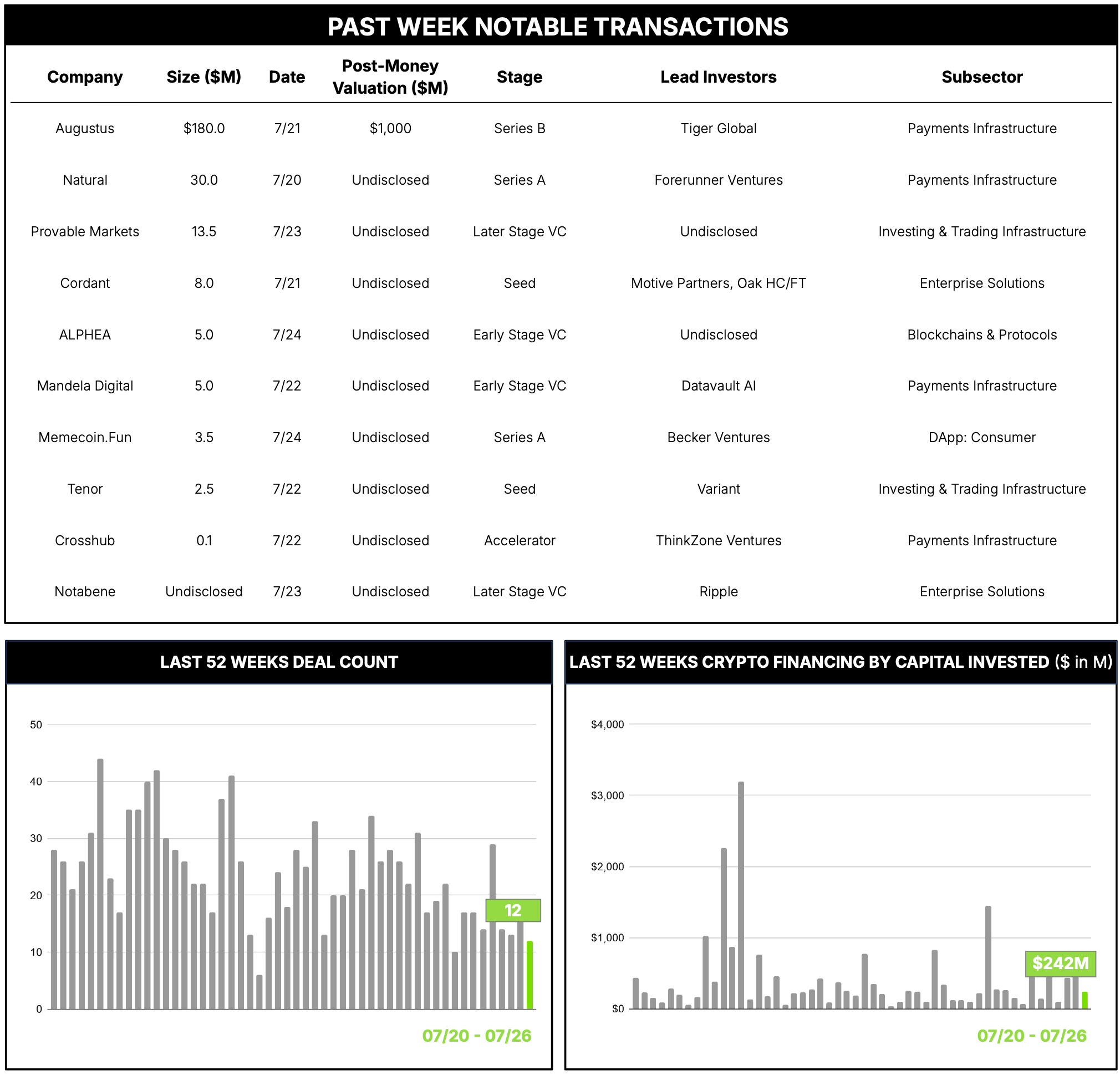
July 20 – July 26 (Published July 31st)
PERSPECTIVES by Steve Payne
12 Crypto Private Financings Raised: $242M
Rolling 3-Month Average: $420M
Rolling 52-Week Average: $428M
Deals Over $50M: 1
Augustus, a fintech building what it calls the “Global Dollar Bank,” raised $180 million in Series B financing led by Tiger Global, with Hummingbird, QED, and the founders of Nubank, Ramp, Circle, and Deel participating, alongside Balaji Srinivasan and firms including Brevan Howard Digital and Variant. The round values the company at $1 billion and brings total funding to $210 million.
Rather than building a consumer or SMB bank, Augustus is pursuing a federally chartered national bank strategy that gives international fintechs and banks direct API access to USD rails, stablecoin rails, and traditional infrastructure (SWIFT, ACH, SEPA) through its “Marble” core banking platform. [Augustus Bank, N.A. received conditional OCC approval in May 2026 for a full-service insured national bank charter rather than the national trust charter most crypto and stablecoin firms have filed for. It can take deposits and make loans, and must obtain FDIC insurance and Federal Reserve Bank stock before it opens.] The distinction from a typical bank is structural. Augustus isn’t selling dollar access to individuals; it’s disintermediating the correspondent banking chain for other financial institutions, offering round-the-clock settlement instead of the batch-processing, multi-hop routing that defines legacy cross-border banking. It’s infrastructure-as-a-bank, positioned to ride both the OCC’s more permissive charter environment and the stablecoin-driven expansion of dollar reach abroad.
Augustus enters a crowded field. The OCC’s December 12, 2025 conditional approvals — Circle, Ripple, BitGo, Paxos, and Fidelity Digital Assets — capped a rush that had begun the prior autumn and has since produced conditional approvals for Bridge, Protego, Crypto.com, Coinbase, Nomura’s Laser Digital, Morgan Stanley, and Sony’s Connectia, with Payoneer and zerohash still pending. Most of these applications are for charters built around custody and stablecoin issuance. Augustus is different: it’s positioning itself as third-party infrastructure for other banks and fintechs. It doesn’t issue a stablecoin today, though its approved business plan includes a wholly owned issuance subsidiary and a tokenized deposit capability.
Tiger Global’s angle is notable. This is a firm that deployed capital at a nearly one-deal-per-day pace in 2021 out of its $6.7 billion PIP 14 fund, then cut volume by over 80% following 2022 markdowns. Its 2024 vehicle, PIP 16, closed at just $2.2 billion against a $6 billion target. Now, Tiger is writing fewer, larger, higher-conviction checks rather than spraying capital broadly.