July 27 – August 2 (Published August 5th)
PERSPECTIVES by Steve Payne
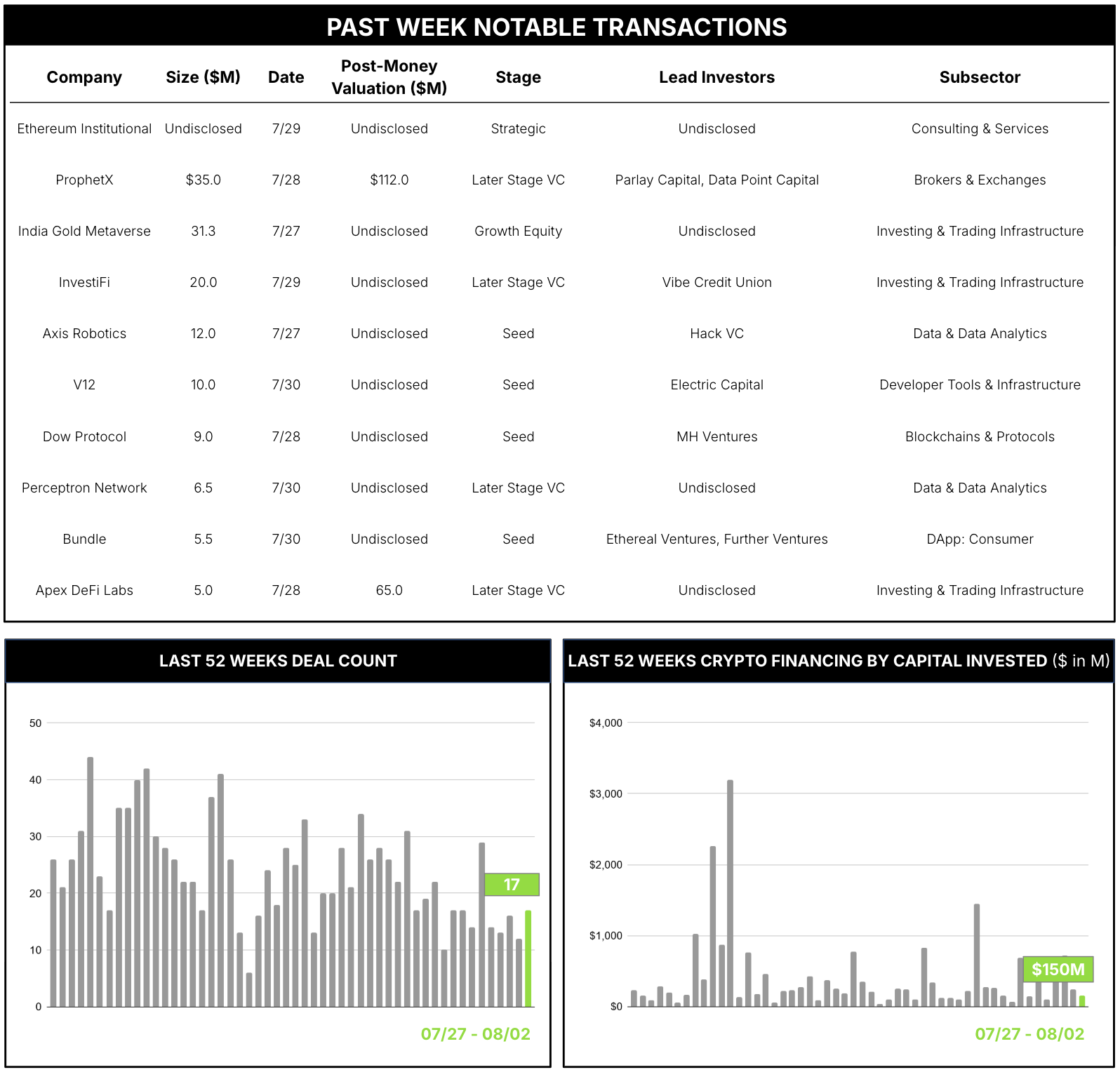
17 Crypto Private Financings Raised: $150M
Rolling 3-Month Average: $320M
Rolling 52-Week Average: $415M
Deals Over $50M: 0
In perhaps the most interesting financing last week, Ethereum Institutional closed its inaugural ecosystem funding round with more than 100 backers and no disclosed dollar figure. None has leaked. DATs BitMine and SharpLink anchored the round alongside Ethereum co-founders Joe Lubin and Mihai Alisie, with participation from 21Shares, Aave, Circle, Curve Finance, Robinhood, Uniswap Labs, Securitize, and ENS Labs.
Ethereum Institutional (EI) launched July 1 as a single entry point for banks, asset managers, custodians, and sovereign institutions working with Ethereum. Its focus is tokenization, stablecoins, collateral systems, and on-chain market infrastructure. It is an independent nonprofit, not a vendor.
EI is deliberately separate from the Ethereum Foundation (EF), which keeps protocol stewardship and R&D. EF reinforced that on July 29 by naming SEAL 911 co-founder Pascal Caversaccio to its board, after a June restructuring cut 20% of staff and refocused it on censorship resistance, open source, privacy, and security. EI is one of three independent organizations EF alumni founded in six weeks, with Ethlabs (protocol research) and EthSystems (institutional privacy), separating commercial outreach from core protocol work.
Even well-capitalized chains struggle to convert institutional interest into deployed capital. Ethereum’s own scaling fix is now a liability: fragmentation across dozens of L2s thins liquidity and raises slippage, and total value secured has slid from roughly $49B at an October 2025 high to $38B in December and $33B today, even as institutional narratives strengthened. Solana’s problem was reliability: seven major outages between 2020 and 2024, including a February 2024 bug that halted the network for five hours by stalling more than 95% of staked validators, all on the same client. Exactly the single-point-of-failure risk institutional risk officers call disqualifying.
Both chains shipped technical fixes, and both show why bodies like EI exist: fixes alone don’t restore institutional trust, and credibly neutral counterparties are increasingly seen as necessary to turn protocol progress into confidence.