ARCHITECT SUCCESSES

SEE ALL
Payward Acquires Magic Labs Embedded Wallet Business

Transaction Overview
On July 27, 2026, Payward, the B2B crypto infrastructure parent behind the crypto exchange Kraken, announced a definitive agreement to acquire wallet-as-a-service business Magic Labs. Financial terms of the transaction were not disclosed.

Target: Magic Labs (Wallet Infrastructure)
Founded in 2018 and headquartered in San Francisco, Magic Labs is a wallet-as-a-service infrastructure provider that enables businesses to create non-custodial embedded wallets for their end users. The company was co-founded by Sean Li, Arthur Jen, and Jaemin Jin.

Magic’s core offering is a developer-facing SDK and API that provides embedded wallets with passwordless authentication via email, social login, passkeys, or SSO. The product suite includes 1) API Wallets for server-side management with security and customizable key sharding, and 2) Embedded Wallets for client-side non-custodial key management. As of July 2026, the platform supports more than 30 blockchain networks and provides a white-label UI, fiat onramps, and transaction signing.

As of July 2026, Magic Labs had provisioned more than 60 million wallets and served more than 200,000 developers across more than 18,000 applications. Clients include Polymarket, Naver, Helium, Forbes, WalletConnect, Mattel, and Immutable. During the 2024 U.S. presidential election, Polymarket processed over $3 billion in prediction market transactions with zero downtime, powered by Magic’s embedded wallets. Magic said it had supported over $8.9 billion in cumulative transaction volume for Polymarket as of November 2025.

Magic Labs has raised a total of $83 million in disclosed venture funding across 4 rounds, with significant investors including PayPal Ventures, Northzone, Tiger Global, Digital Currency Group, CoinFund, and Placeholder VC.

In November 2024, Magic Labs announced Newton, a chain unification network built in collaboration with Polygon Labs, expanding beyond wallet infrastructure into cross-chain protocol development. In November 2025, Magic Labs integrated the Newton Protocol SDK across its developer network. The company described Newton Protocol as “the authorization layer for on-chain finance.” These moves preceded the company’s decision to divest its wallet business and refocus entirely on protocol development.

Buyer: Payward
Founded in 2011 and headquartered in San Francisco, Payward is a private B2B crypto infrastructure holding company. Payward operates Kraken, one of the longest-running cryptocurrency exchanges, alongside NinjaTrader, xStocks, Bitnomial, and CF Benchmarks. The company is led by co-CEOs Arjun Sethi and Dave Ripley.

Most relevant to this transaction, Payward operates Payward Services, a B2B infrastructure platform that provides institutions with access to Payward’s trading, custody, settlement, and payments infrastructure via API. The acquisition of Magic Labs adds embedded wallet infrastructure to their offering. In April 2026, Payward launched a white-label fiat-to-crypto onramp through a partnership with Onramper, making embedded wallet infrastructure a natural adjacent capability.

Payward has been expanding beyond its core exchange through acquisition. In 2025, the company acquired NinjaTrader for $1.5 billion (retail futures, M&A Alert) and agreed to acquire Backed Finance (tokenized equities, Press). In 2026, it acquired Magna (token lifecycle management, Press), completed the acquisition of Bitnomial for up to $550 million (regulated derivatives, M&A Alert), and agreed to acquire Reap for $600 million (card issuance and payments, M&A Alert). Including this transaction, Payward has announced or completed 8 acquisitions since early 2025, committing several billion dollars to platform expansion ahead of its planned public listing.

For the full year of 2025, Payward reported adjusted revenue of $2.2 billion, a 33% increase year over year from $1.5 billion in 2024. Trading-based revenue accounted for 47% of the total, with the remaining 53% from asset-based services, including payments, custody, yield, and financing.

In November 2025, Payward raised $800 million at a $20 billion post-money valuation in a round backed by Citadel Securities, Jane Street, and Apollo Global Management, and confidentially filed an S-1 with the SEC ahead of a planned IPO. In April 2026, Deutsche Börse Group made an additional $200 million strategic investment in the company.

Transaction Parameters
Payward has signed a definitive agreement to acquire the wallet-as-a-service business of Magic Labs for an undisclosed amount. The transaction includes Magic Labs’ embedded wallet business, including wallet clients and associated infrastructure.

The transaction is part of a broader corporate restructuring in which Magic Labs is rebranding as Newton Labs to focus on the Newton Protocol. The two companies will remain independent following the close.

Architect Partners served as the exclusive financial advisor to Magic Labs.

Strategic Rationale
Payward is acquiring Magic’s embedded wallet business to augment Payward Services’ B2B offering. Payward Services gives partners a single integration point for trading, custody, tokenized assets, on/off-ramps, and derivatives. The wallet, the account layer where end users actually hold assets and interact with onchain products, was a critical piece partners still had to source from a third party. Magic brings that layer in-house with proven infrastructure: a TEE-based signing solution, an embedded integration layer, and a developer SDK that together have provisioned more than 60 million wallets and supported over $10 billion in stablecoin volume for 200,000+ developers.

On Day 1, Payward can offer fintechs, enterprises, and financial institutions a complete embedded onchain offering under a single provider, spanning wallet provisioning, onboarding, funding, trading, custody, and settlement, without stitching together multiple vendors. Every embedded wallet also becomes a distribution point that routes transaction volume into the rest of Payward’s infrastructure, deepening the non-trading, less volatile revenue that already accounts for 53% of Payward’s total as it heads toward a public listing.

Architect Partners’ Observations
This transaction marks the near-completion of a consolidation wave in embedded wallet infrastructure. In roughly one year, Fireblocks acquired Dynamics ($90M), Consensys acquired Web3Auth ($50M), Stripe acquired Privvy, Ripple acquired Palisade, and Paxos acquired Fordefi. Now each group has its own independent wallet infrastructure provider, and Payward has acquired the category’s pioneer. The market has reached a clear verdict: embedded wallets are foundational infrastructure for every onchain product, and they are a layer of a full-stack platform rather than a standalone business.

The logic is simple: the wallet is becoming the account primitive of onchain finance. Whoever provisions the wallet sits at the front of the customer relationship and routes the volume that follows. For platforms whose trading revenue is inherently cyclical, owning the onboarding layer converts market position into durable, recurring B2B infrastructure revenue.

Sources
Press Release, Payward Services, PitchBook

Insights

Q1 2024 Crypto M&A and Financing Report

Elliot Chun
April 4, 2024
DOWNLOAD FULL REPORT

Download the full report above.

Crypto Mergers & Acquisitions


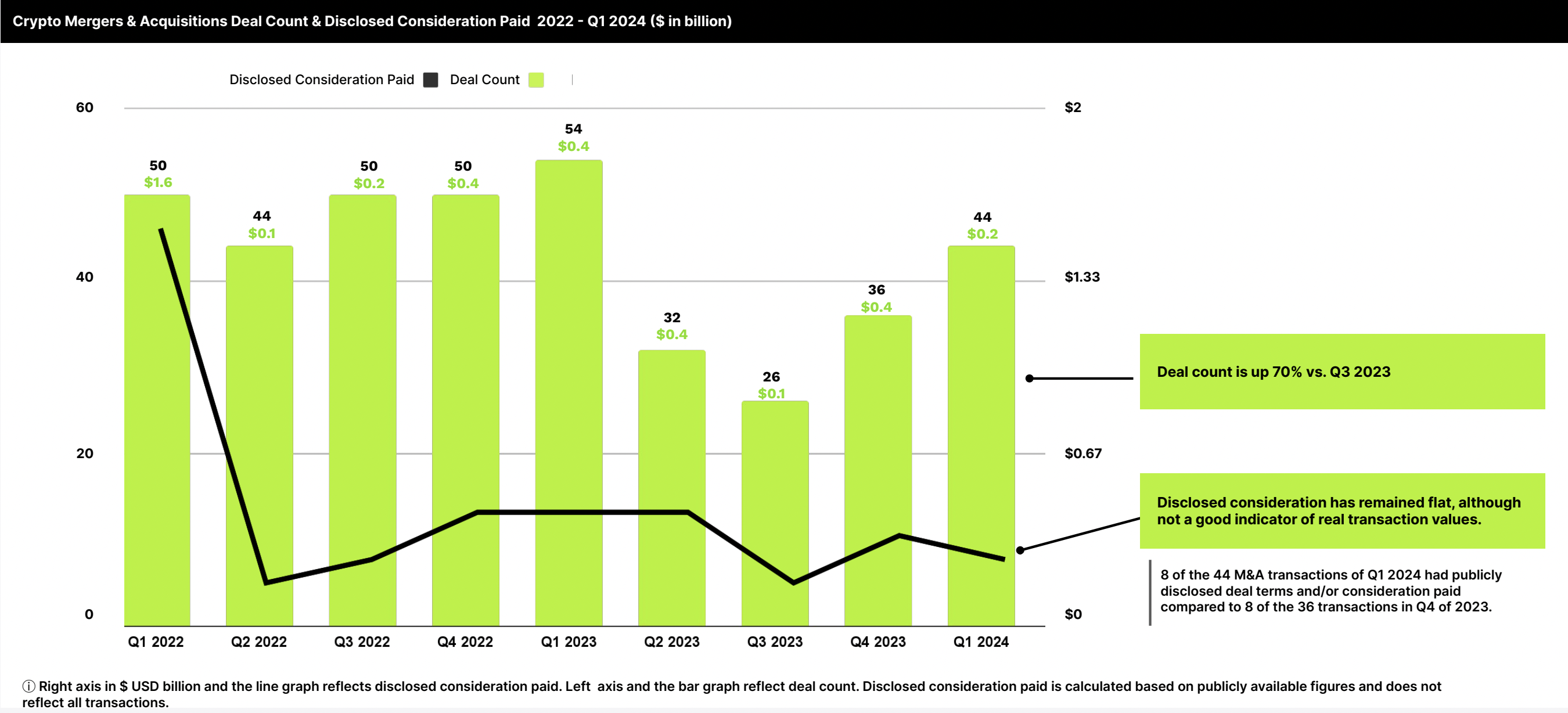
The market tone continues to improve, but M&A activity is still running below 2022 levels.


Announced M&A deal activity in Q1 2024 was up 22% from the previous quarter – good news indeed, but still below the pace of the peak year 2022. The crypto sector’s announced deal activity improved a bit more than the overall tech sector deal activity, in contrast to an observed decline in announced fintech deals last quarter. (Note that most announced crypto deals do not have an announced value, so deal value is not an accurate indicator.)


In Q4 2023, 39% of crypto deals were in the Brokers & Exchanges or Investing & Trading Infrastructure subsectors.  This trend continued in Q1, with 45% of deals in the same two leading sectors.


The share of “bridge transaction” deals in which a non-crypto native firm acquired a crypto-native firm inched up to 25% last quarter, indicating increased comfort with the sector. 


Valkyrie Funds | CoinShares, Brassica | BitGo, and the three-way combination of SingularityNET, fetch.ai, and Ocean Protocol into the Artificial Superintelligence Alliance (at a whopping $7.5B notional value) were the headline M&A deals in Q1.
Crypto Private Financings


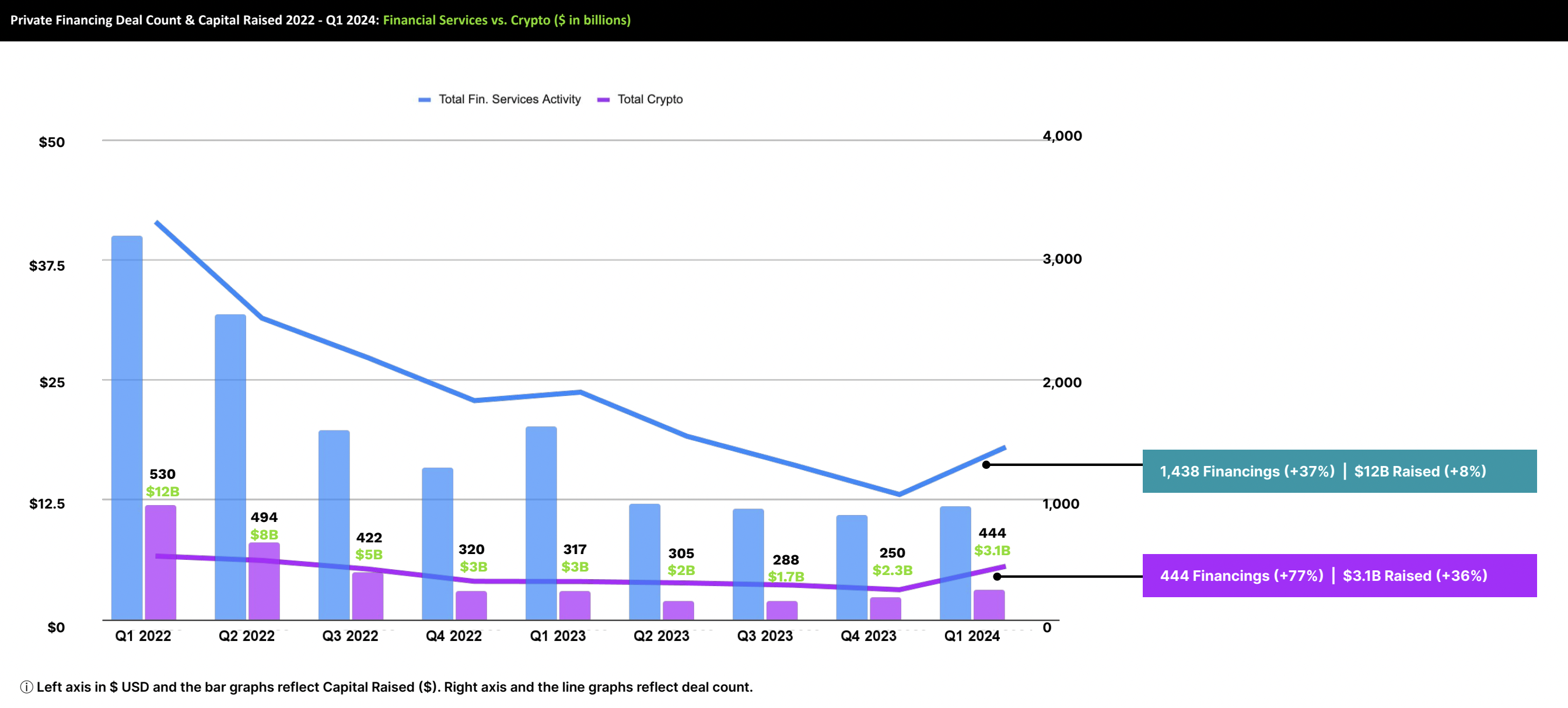
A significant rebound compared to 2023, but there is a lack of conviction in later-stage growth capital financings.


Disclosed private financings increased significantly in Q1 from Q4 2023, with capital raised increasing by 36% and the number of financings increasing by 77%. However, if the pace from Q1 remains for the rest of 2024, the financings market would be at $12.4 billion in capital raised, still over 50% lower than the levels seen in 2021 and 2022.


Part of this decrease is likely due to the lack of significant, large-scale, later-stage growth capital rounds. In 2020-2022, there were numerous $100 million+ deals completed every week. This quarter, however, there were only four, of which two were earlier stage/seed stage deals.


On this theme, there was a 112% increase from Q4 2023 to Q1 2024 in the number of early-stage financings but only a 32% increase for later-stage financings. In addition, seed-stage financings attracted a 108% increase in capital, while later-stage financings only attracted 25% more.

Crypto Public Companies


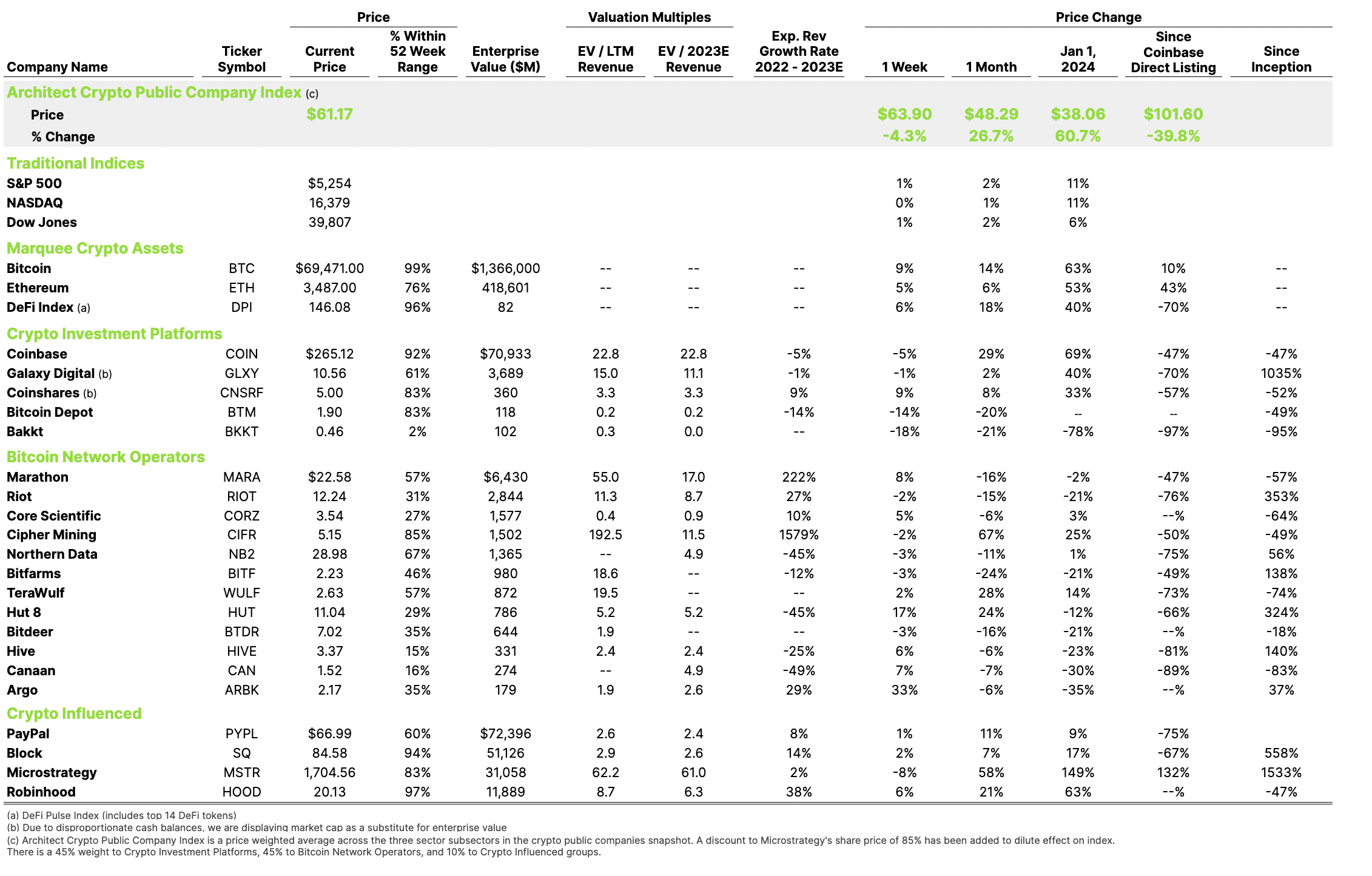
Public crypto markets had mixed results in Q1.    


Bitcoin rallied from $42,000 in January to $72,000 by March 12, setting a new all-time high. For the quarter, bitcoin was up 63%, and Ethereum was up 53%. There were several factors driving the price of bitcoin, including the approval of spot bitcoin ETFs, the upcoming bitcoin halving, uncertain and volatile macroeconomic and global political conditions, and an overall surge in institutional support.


With bitcoin’s price appreciation, trading volumes are generally higher, allowing exchanges to benefit from higher transaction fees and commissions. Many of the stronger crypto exchanges saw high share price appreciation during Q1, with Coinbase up 69%, Galaxy Digital up 40%, and Coinshares up 31%.


On the flip side, despite the run-up in bitcoin, the majority of bitcoin miners saw their share prices decline. This decline is attributed to the correlation of bitcoin prices to hash rates and the impact on profitability, the halving, and the proposed 30% excise tax on miners’ energy use.