ARCHITECT SUCCESSES

SEE ALL
Coinme Acquired by Polygon Labs to Build its Open Money Stack

Transaction Overview
On January 13th, 2026, Polygon Labs announced it intends to acquire Coinme, a regulated crypto-as-a-service provider. Simultaneously, Polygon also announced the acquisition of Sequence, enabling payment flows across blockchain networks. Both acquisitions help build a fully integrated, rules-compliant stablecoin payments system – Poygon’s Open Money Stack.

Target: Coinme
Founded in 2014 and headquartered in Seattle, Coinme is a U.S.-regulated digital asset payments company offering crypto-as-a-service and stablecoin and crypto payment infrastructure for enterprises, fintechs, wallets, and payment applications.

Coinme is licensed and operates in 48 U.S. states, as well as Puerto Rico, and has built systems designed to handle fiat-to-crypto and stablecoin payments at scale while meeting U.S. regulatory requirements.

Coinme provides capabilities that partners integrate into their products. These capabilities, delivered as a set of APIs or SDKs, include KYC, payments by debit card, bank transfer, or cash, converting between fiat and crypto, trading, and custody, so partners can offer end-to-end crypto and stablecoin features embedded in their own applications.

Coinme also supports a large cash-to-crypto network through partnerships, providing the software and compliance layer that enables cash on-ramps and off-ramps at 50,000+ locations across the U.S.

Coinme serves more than one million users and has processed more than $1.3 billion in total transactions since it launched. Its enterprise customers include Coinstar, Exodus, Mercuryo, Baanx, and Breeze.

Coinme was co-founded by CEO Neil Bergquist and has raised $41M in equity funding from Pantera, Digital Currency Group, Coinstar, Circle, and MoneyGram.

Coinme competitors include: ZeroHash, MoonPay, Bridge | Stripe, Banxa | OSL, and Paxos.

Buyer: Polygon Labs
Polygon was founded in 2017 as Matic Network and is actively undergoing an evolution in its product offering. Polygon Labs, formed in 2023, is responsible for supporting the development of the Polygon ecosystem, with a focus on fast, low-cost blockchain infrastructure for payments.

Polygon is now building the Open Money Stack, an integrated set of services designed to move money instantly and reliably, globally. It combines blockchain settlement on the Polygon network with core payment components like wallets, stablecoin integrations, cross-chain connectivity, and compliance tooling, to keep funds on-chain so they can be used across on-chain financial applications.

To make this work across many different blockchains, Polygon Labs is building AggLayer, a settlement layer meant to help different blockchains connect and exchange value with each other quickly and at low cost, reducing the need for separate, disconnected systems.

Polygon is a listed token with a current fully diluted value of $1.6B. Polygonscan shows more than 6.2 billion total transactions on Polygon. Polygon’s website also points to scale indicators like billions of dollars of stablecoins on the network, millions of transactions per day on average, and monthly payment volume, and describes Polygon as infrastructure that can support “trillions” of value moving through it.

The company was co-founded by Jaynti Kanani, Sandeep Nailwal, Mihailo Bjelic, and Anurag Arjun, and is currently led by CEO Marc Boiron, who was appointed in 2023.

Historically, in 2021, Polygon acquired zero-knowledge cryptography companies Mir and Hermez for $400M and $250M, respectively, but these are no longer aligned with the company’s Open Money Stack vision.

Transaction Parameters
Polygon Labs is acquiring Coinme for an undisclosed amount. In combination with another acquisition, Sequence, simultaneously announced by Polygon today. The combined acquisition value is around $250M. This marks one of the first examples of a protocol acquiring an operating business. The Coinme transaction is expected to close in Q2 2026.

Architect Partners served as the exclusive financial advisor to Coinme.

Notable comparable transactions include OSL | Banxa for $62M (M&A Alert), Nuvei | Simplex for $250M (M&A Alert), Ripple | Rail for $200M (M&A Alert), Stripe | Bridge for $1.1B (M&A Alert), MoonPay | Iron for $100M (M&A Alert), and MoonPay | Helio for $175M (M&A Alert).

Strategic Rationale
Polygon is acquiring Coinme and Sequence to move from being a settlement rail to owning the full experience of how money comes on-chain, moves on-chain, and settles back into the real world. The combination of Coinme’s licensed payments offering with Sequence’s wallet and payments orchestration stack gives Polygon an end‑to‑end, regulated crypto payments platform that spans physical kiosks, embedded wallets, and cross‑chain routing.

On Day 1, Polygon can take this integrated “crypto‑as‑a‑service” solution to banks, PSPs, neobanks, and fintechs who want compliant, turnkey stablecoin and token payments without building their own licensing, infrastructure, or user experience.

Architect Partners’ Observations
This acquisition(s) underscores a broader inflection point in the blockchain protocol market: technological performance and scalability alone will not win. The integration of real-world rails and the ability to deliver end-to-end value for mainstream users are becoming table stakes. As the market matures, competitive advantage is shifting toward owning the commercialization layer, including regulated fiat access, compliance operations, distribution channels, partner integrations, and strong product integration.

Networks that rely entirely on third-party providers risk commoditization, margin leakage, inconsistent user experience, and strategic dependency, just as stablecoins and tokenized products begin to drive meaningful transaction volume and the corresponding revenue opportunities.
Polygon’s actions show they fully understand the importance of this approach.

Sources
Polygon Press Release
Architect Partner M&A Tracker
PitchBook

Insights

Week of May 26 – June 01

Todd White
June 04, 2025
DOWNLOAD FULL REPORT

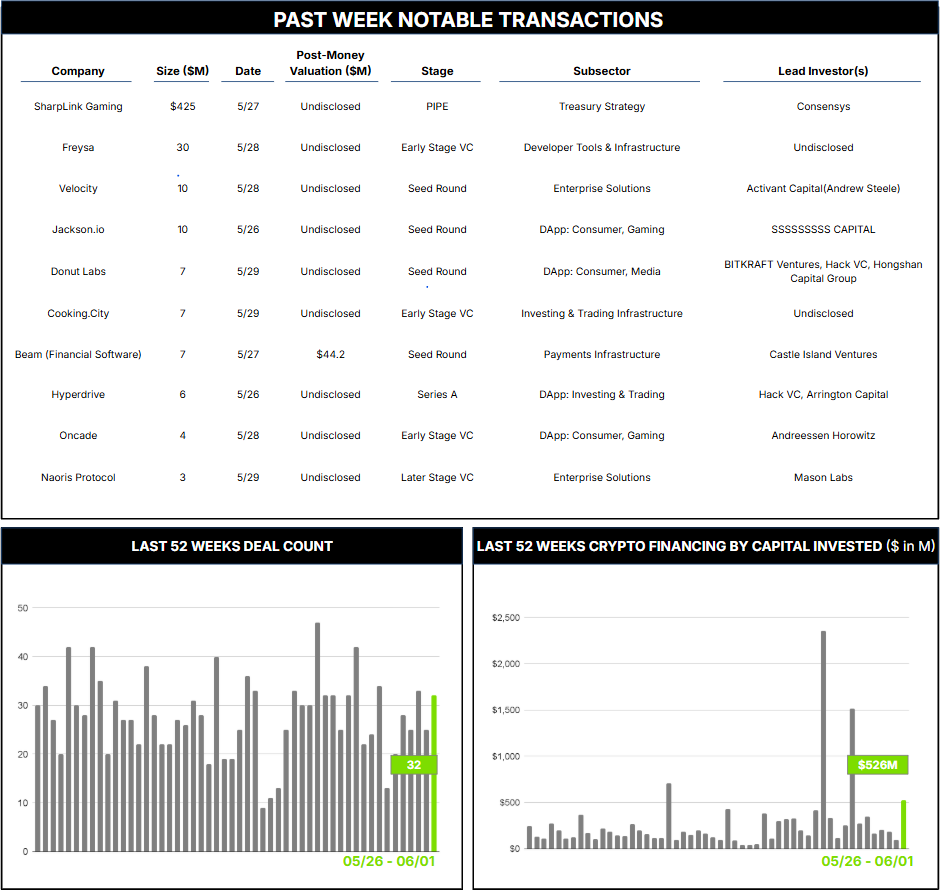
May 26 – June 01 (Published June 4th)

PERSPECTIVES by Todd White


32 Crypto Private Financings Raised: $526.3M

Rolling 3-Month-Average: $530.6M

Rolling 52-Week Average: $274.5M


The adoption of crypto-treasury strategies (where companies allocate a portion of their balance sheet to digital assets like Bitcoin, Ethereum, Solana, and even stablecoins) has accelerated since 2021, with both tech giants and smaller firms participating. This trend has the potential to reshape corporate finance, but it also brings significant risks.


Several prominent companies have pioneered or adopted crypto-treasury strategies, most focused on Bitcoin. Strategy (fka MicroStrategy) is the most notable example and now holds the largest Bitcoin treasury among public companies, with 580,955 BTC as of June 2025, purchased at an average price of $70,023. The company began aggressively accumulating BTC in 2020 under CEO Michael Saylor, who views Bitcoin as a superior store of value and has emerged as a vocal advocate for Bitcoin as a treasury asset. Other groups focused on Bitcoin treasuries include miner Marathon Digital, which accumulates and retains BTC as part of its core mining activities; LatAm fintech giant MercadoLibre, which integrates crypto into its payment ecosystem and uses its crypto holdings for transactions in addition to holding the assets on its balance sheet; and 21 Capital, a newly formed Bitcoin-native financial company created by Tether, Bitfinex, and SoftBank through a reverse merger with Cantor Equity Partners, Inc. (CEP), a Nasdaq-listed special-purpose acquisition company (SPAC) sponsored by Cantor Fitzgerald, and positioned to be led by Jack Mallers, a prominent Bitcoin advocate and CEO of Strike.


Other assets are also being utilized, including ETH, SOL, and XRP. SharpLink Gaming, a Nasdaq-listed marketing company servicing the online sports-betting and gaming sectors, is emerging as a leading advocate for Ethereum-based treasury strategies with its announced $425 million PIPE financing this week in order to acquire Ethereum as the company’s primary treasury-reserve asset. There are numerous other examples; by our count, at least 36 groups have announced crypto-based treasury ambitions over just the last few months.


Amid this surge, there are, of course, numerous advocates and skeptics alike. Advocates often cite several putative benefits, including the potential for high returns, hedging against inflation and currency debasement, portfolio diversification, and even strategic branding as an innovative company. Detractors quickly counter with the risks of extreme volatility, uncertain regulatory and accounting treatment, inherent security and custody challenges, operational complexities, and more.


However the debate unfolds, the public markets appear to approve for the moment. Investors currently trade crypto-treasury companies at a notable premium, between two and three times the price of the underlying asset. Most adopters, SharpLink included, intend to continue operating their core businesses rather than pivot entirely to crypto accumulation. Even 21 Capital, launched on the basis of its BTC strategy, intends to complement its treasury activity by developing a suite of BTC-enabled financial products that will provide a core level of business activity. Strategy, on the other hand, has pivoted to an almost pure treasury play.


Whether, and when, the music will stop and the trading premium diminishes (or worse) remains to be seen. For now, momentum seems to be increasing, and we will track the relative wisdom or folly of this growing cohort with keen interest.


Contact ryan@architectpartners.com to schedule a meeting.