ARCHITECT SUCCESSES

SEE ALL
Coinme Acquired by Polygon Labs to Build its Open Money Stack

Transaction Overview
On January 13th, 2026, Polygon Labs announced it intends to acquire Coinme, a regulated crypto-as-a-service provider. Simultaneously, Polygon also announced the acquisition of Sequence, enabling payment flows across blockchain networks. Both acquisitions help build a fully integrated, rules-compliant stablecoin payments system – Poygon’s Open Money Stack.

Target: Coinme
Founded in 2014 and headquartered in Seattle, Coinme is a U.S.-regulated digital asset payments company offering crypto-as-a-service and stablecoin and crypto payment infrastructure for enterprises, fintechs, wallets, and payment applications.

Coinme is licensed and operates in 48 U.S. states, as well as Puerto Rico, and has built systems designed to handle fiat-to-crypto and stablecoin payments at scale while meeting U.S. regulatory requirements.

Coinme provides capabilities that partners integrate into their products. These capabilities, delivered as a set of APIs or SDKs, include KYC, payments by debit card, bank transfer, or cash, converting between fiat and crypto, trading, and custody, so partners can offer end-to-end crypto and stablecoin features embedded in their own applications.

Coinme also supports a large cash-to-crypto network through partnerships, providing the software and compliance layer that enables cash on-ramps and off-ramps at 50,000+ locations across the U.S.

Coinme serves more than one million users and has processed more than $1.3 billion in total transactions since it launched. Its enterprise customers include Coinstar, Exodus, Mercuryo, Baanx, and Breeze.

Coinme was co-founded by CEO Neil Bergquist and has raised $41M in equity funding from Pantera, Digital Currency Group, Coinstar, Circle, and MoneyGram.

Coinme competitors include: ZeroHash, MoonPay, Bridge | Stripe, Banxa | OSL, and Paxos.

Buyer: Polygon Labs
Polygon was founded in 2017 as Matic Network and is actively undergoing an evolution in its product offering. Polygon Labs, formed in 2023, is responsible for supporting the development of the Polygon ecosystem, with a focus on fast, low-cost blockchain infrastructure for payments.

Polygon is now building the Open Money Stack, an integrated set of services designed to move money instantly and reliably, globally. It combines blockchain settlement on the Polygon network with core payment components like wallets, stablecoin integrations, cross-chain connectivity, and compliance tooling, to keep funds on-chain so they can be used across on-chain financial applications.

To make this work across many different blockchains, Polygon Labs is building AggLayer, a settlement layer meant to help different blockchains connect and exchange value with each other quickly and at low cost, reducing the need for separate, disconnected systems.

Polygon is a listed token with a current fully diluted value of $1.6B. Polygonscan shows more than 6.2 billion total transactions on Polygon. Polygon’s website also points to scale indicators like billions of dollars of stablecoins on the network, millions of transactions per day on average, and monthly payment volume, and describes Polygon as infrastructure that can support “trillions” of value moving through it.

The company was co-founded by Jaynti Kanani, Sandeep Nailwal, Mihailo Bjelic, and Anurag Arjun, and is currently led by CEO Marc Boiron, who was appointed in 2023.

Historically, in 2021, Polygon acquired zero-knowledge cryptography companies Mir and Hermez for $400M and $250M, respectively, but these are no longer aligned with the company’s Open Money Stack vision.

Transaction Parameters
Polygon Labs is acquiring Coinme for an undisclosed amount. In combination with another acquisition, Sequence, simultaneously announced by Polygon today. The combined acquisition value is around $250M. This marks one of the first examples of a protocol acquiring an operating business. The Coinme transaction is expected to close in Q2 2026.

Architect Partners served as the exclusive financial advisor to Coinme.

Notable comparable transactions include OSL | Banxa for $62M (M&A Alert), Nuvei | Simplex for $250M (M&A Alert), Ripple | Rail for $200M (M&A Alert), Stripe | Bridge for $1.1B (M&A Alert), MoonPay | Iron for $100M (M&A Alert), and MoonPay | Helio for $175M (M&A Alert).

Strategic Rationale
Polygon is acquiring Coinme and Sequence to move from being a settlement rail to owning the full experience of how money comes on-chain, moves on-chain, and settles back into the real world. The combination of Coinme’s licensed payments offering with Sequence’s wallet and payments orchestration stack gives Polygon an end‑to‑end, regulated crypto payments platform that spans physical kiosks, embedded wallets, and cross‑chain routing.

On Day 1, Polygon can take this integrated “crypto‑as‑a‑service” solution to banks, PSPs, neobanks, and fintechs who want compliant, turnkey stablecoin and token payments without building their own licensing, infrastructure, or user experience.

Architect Partners’ Observations
This acquisition(s) underscores a broader inflection point in the blockchain protocol market: technological performance and scalability alone will not win. The integration of real-world rails and the ability to deliver end-to-end value for mainstream users are becoming table stakes. As the market matures, competitive advantage is shifting toward owning the commercialization layer, including regulated fiat access, compliance operations, distribution channels, partner integrations, and strong product integration.

Networks that rely entirely on third-party providers risk commoditization, margin leakage, inconsistent user experience, and strategic dependency, just as stablecoins and tokenized products begin to drive meaningful transaction volume and the corresponding revenue opportunities.
Polygon’s actions show they fully understand the importance of this approach.

Sources
Polygon Press Release
Architect Partner M&A Tracker
PitchBook

Crypto Public Companies Snapshot

Crypto Public Companies Snapshot

Elliot Chun
June 6, 2025
DOWNLOAD FULL REPORT

Is the crypto treasury strategy for public companies a short-term memecoin phase or a permanent shift in how treasuries will be managed in the long term?


(Circle completed a successful IPO this week, which we alluded to in our Financings Alert, and we will cover the impact of CRCL in next week’s Perspectives.)


While this topic is fiercely debated at Architect Partners, I believe this moment represents a shift in how the treasuries of public companies will be managed going forward. As with all things related to crypto, quality execution is critical. Only the best implementers of this strategy will deliver the promised benefits to their shareholders.


Will public-company shareholders see sustainable value created from adding crypto to their balance sheets that results in long-term stock price appreciation? This is the key question that must be answered.


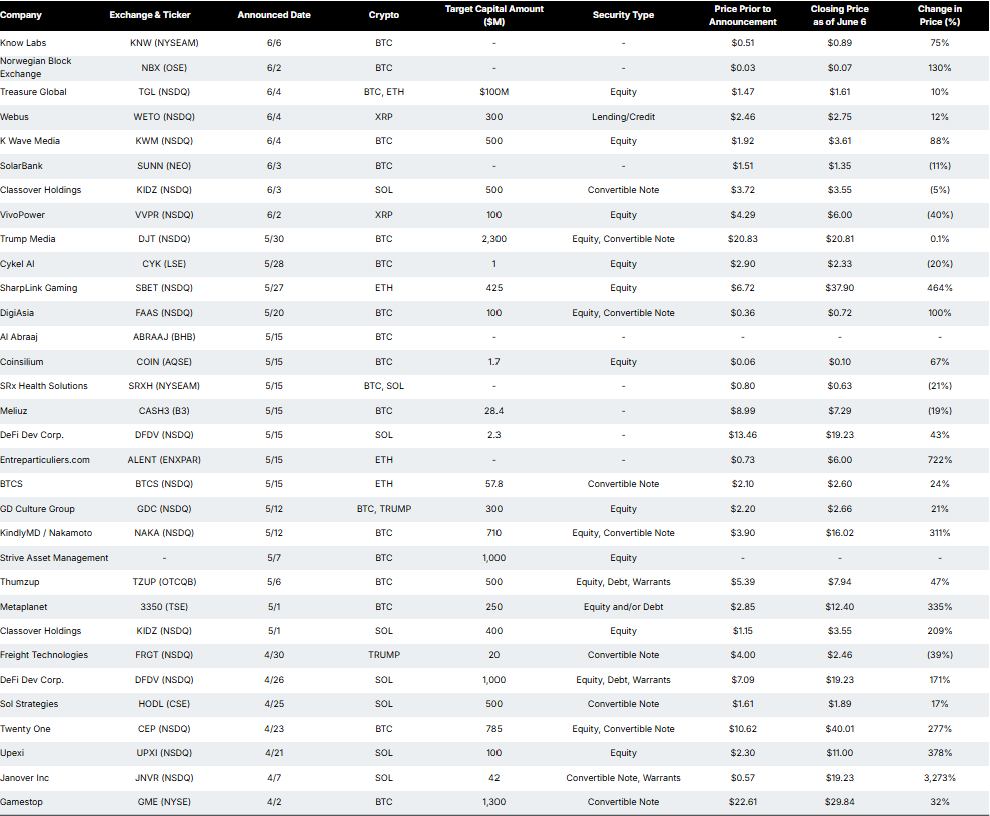
Since April 2, thirty-two public companies have announced a crypto treasury strategy with intentions to raise over $11.3 billion in capital. Twenty-six of those companies are trading higher since their respective announcements (many are trading lower than their initial price increase).


To understand whether this is a phase or a permanent shift, we ask the following questions:


What is the role of treasury management?
The crypto industry does not do a good job of using TradFi vernacular, so it is important to define what treasury management is. Responsibilities include collecting revenues, paying expenses, ensuring working capital for operations, and managing financial assets. Management of financial assets encompasses preserving value, mitigating risks (FX volatility, interest rates), and maximizing returns within risk tolerance, which is typically very low.


Implementing the crypto treasury strategy typically falls here, which brings us to the first issue: Is the crypto treasury strategy a preservation-of-value and risk-mitigant activity, or is it an investment activity? We will find out soon.


Is this shorter-term financial engineering or a truly longer-term shift in how corporate treasuries will be managed?
Objective observers see this strategy as raising public capital to buy an asset that is already publicly available. Why should that result in a higher stock price? Additionally, what happens when the crypto assets held in the treasury move 25 percent lower, which will most assuredly happen?


From a longer-term perspective, we are seeing the development of four types of crypto treasury strategies:


Accumulate and Hold

  • The objective is to buy the crypto asset and simply hold it long term on the balance sheet.
  •  MicroStrategy (MSTR) is the best example.


Accumulate and Generate Yield on the Treasury Assets

  • The objective is to buy the crypto asset and use that asset to generate yield.
  •  Companies such as SOL Strategies and SharpLink, which buy proof-of-stake assets (SOL, ETH), are examples.


Accumulate and Build Products and Services that Produce the Treasury Asset

  • The objective is to buy the crypto asset and build a business that generates revenue in that crypto asset.
  • Bitcoin miners are an example.
  • Twenty One Capital appears to aspire to this model as well: “Twenty One intends to develop a corporate architecture capable of supporting financial products built with and on Bitcoin. This includes native lending models, capital market instruments, and future innovations that will replace legacy financial tools with Bitcoin-aligned alternatives.”


Accept the Treasury Assets as Payment for Existing Goods and Services and Hold

  • The objective is to use the crypto asset as a payment rail and, once received as payment, keep the crypto asset and not convert it to fiat.
  • Block and Tesla are examples.


Who is executing the strategy, what is their background, and how crypto-native are they?
In crypto, it is vital to recognize that there is a massive difference between an announcement and execution. Interacting with crypto assets in an institutionally secure and responsible way is much more important than managing fiat. The operational fortitude and acceptance of the volatility inherent in crypto assets require a crypto-native way of thinking and executing. The “who” behind the crypto treasury strategy will be the most important factor for long-term sustainability.


Much has been written, and much more will be written, about the controversial crypto treasury strategy.


I believe that while the majority of today’s announcements will not succeed in the long term, we will still be actively speaking about this strategy in 2030 and looking back at how the best-performing publicly traded companies have crypto assets on their balance sheets.