The New Digital Asset Public Company Index
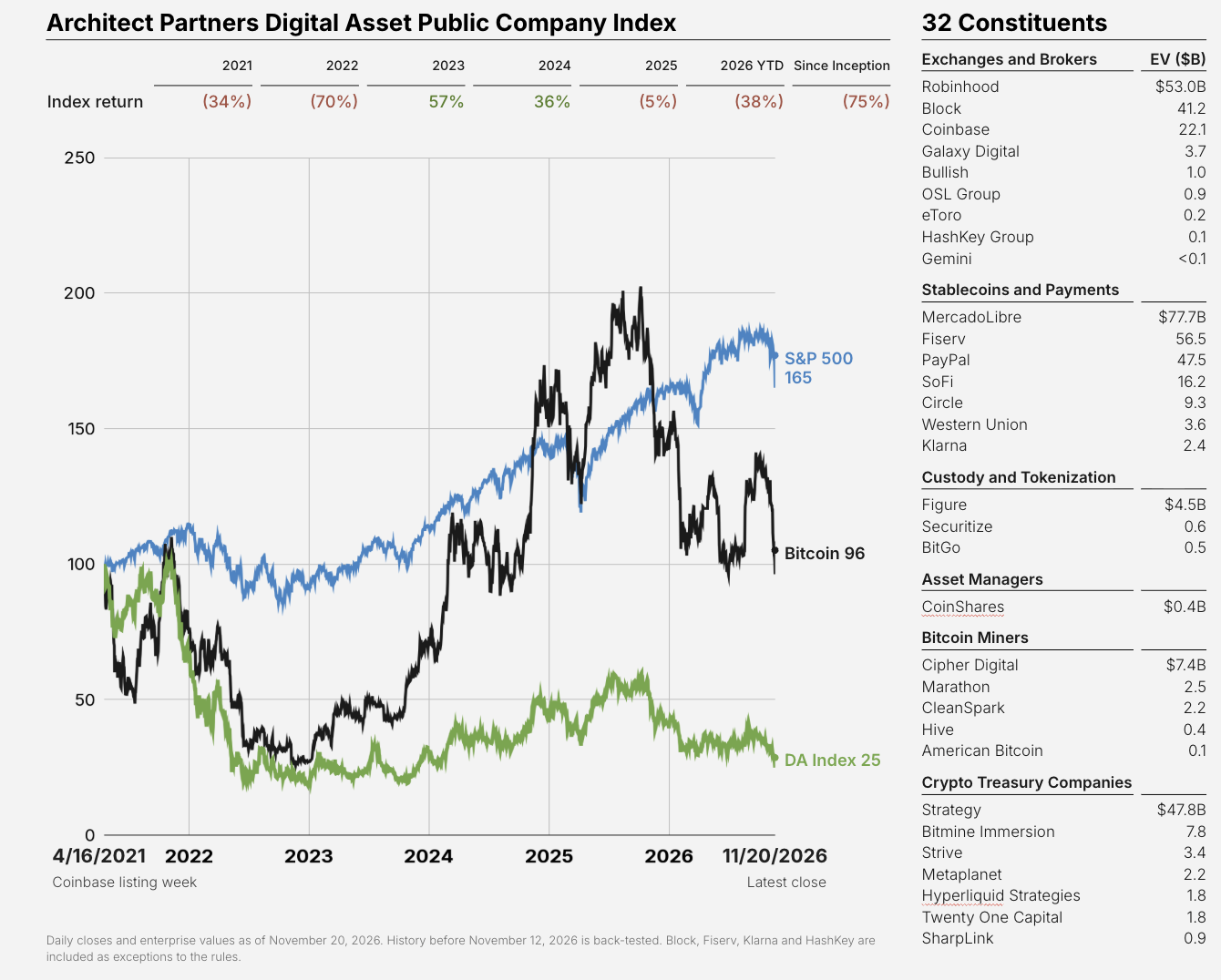
We’ve officially recrafted the AP Crypto Index to be more complete and better defined, and renamed it the Architect Partners Digital Asset Public Company Index. The goal is a clear benchmark for how the public markets value digital asset companies.
We rebuilt it to capture the value moving into stablecoins and payments, rely less on crypto trading businesses, and set precise rules for which companies get in. PayPal, MercadoLibre, SoFi and Western Union have each launched their own stablecoin, and stablecoin and payments companies are now 47% of the index’s $375B, ahead of exchanges and brokers at 36%.
What Changed
The old index leaned toward smaller digital asset companies, with brokers and exchanges making up 12 of its 28 names, and it left out most of the stablecoin and payments companies. Now the rules are black and white: a market cap over $200M, at least $1M of stock traded a day, and 10% of revenue from digital assets or its own live stablecoin. Miners and treasury companies have their own tests. We run every public digital asset company we follow through these rules each quarter. Companies are weighted by market cap, and a new listing joins three months after it starts trading. Just like before, the history starts the week of Coinbase’s direct listing.
Performance
The index is down 38% this year, slightly more than bitcoin’s 33%. Operating companies in our index are still expected to grow revenue about 13% this year, but trade at roughly half the revenue multiple they did at the start of the year. The index is really two groups: digital asset-native companies (about 30% of its value) still move with bitcoin and fell 50%, while fintechs with digital asset businesses (about 70%) fell 30% even as the S&P 500 rose 1%. Most of the drop came in Q4, after the Binance hack, leaving the median company at 1% of its 52-week range, near its low, against 39% for the S&P 500. Trading has slowed, but stablecoin payments grew 45% to $482B through September, about what PayPal handled in Q3 alone. That leaves stablecoin and payments companies room to scale, and as they do, we expect the stocks to reprice.