October 19 – October 25 (Published October 28)
PERSPECTIVES by Adlee Heshmat
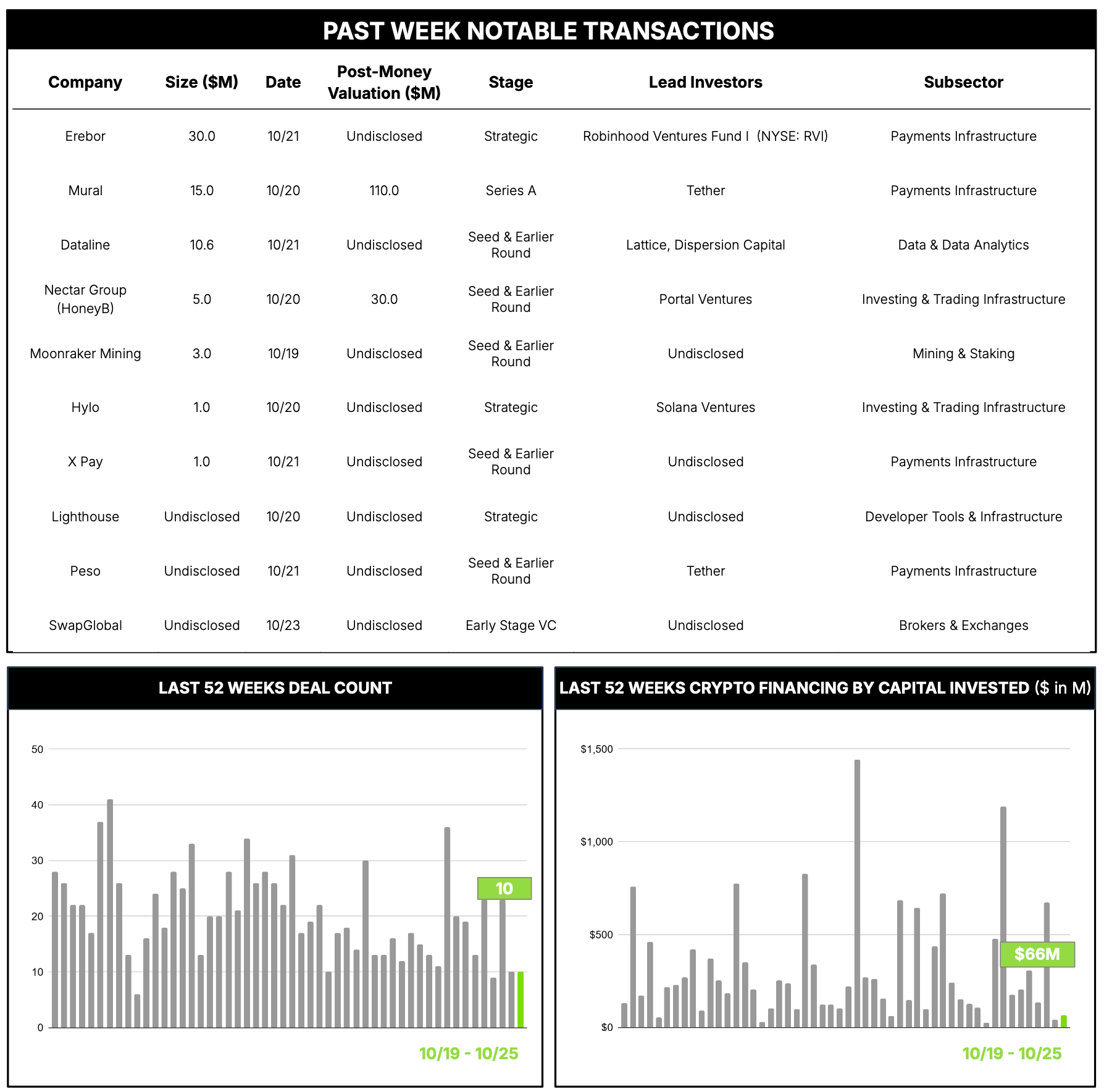
10 Crypto Private Financings Raised: $66M
Rolling 3-Month Average: $293M
Rolling 52-Week Average: $312M
Deals Over $50M: 0
Another quiet week: the sixth-slowest in the past 52-weeks by dollars raised.
The biggest deal was Robinhood Ventures Fund I (NYSE: RVI), which bought $30M of preferred stock in Erebor, the Columbus, Ohio bank co-founded last year by Palmer Luckey. The deal closed on September 17 but wasn’t announced until October 21. No valuation was disclosed.
Erebor received its charter in February. Deposits have since grown from $1.1B at the end of March to more than $7B, with crypto, AI and defense clients driving much of the growth. For its first three years, the FDIC requires the bank to hold capital equal to at least 12% of its assets. As deposits grow, so does the capital it needs. The FT reported in August that Erebor was in advanced talks to raise about $1.5B at a valuation of roughly $9.5B, partly to meet that need. PitchBook still lists the round as pending. RVI’s $30M is a small piece of that.
Mural, the week’s second-largest deal, is a licensed money transmitter. Payroll providers, software companies and fintechs use its platform to manage dollars, local currencies and stablecoins through one account. The company says it has processed $2.1B across 128 countries since its API went live in 2025. Tether led Mural’s $15M Series A, its fourth lead investment in our tracker over the past two weeks. North Island Ventures also joined, bringing Mural’s total funding to $28M. The company didn’t disclose a valuation. It started in 2022 with treasury tools for DAOs.
Mural doesn’t take deposits, so it doesn’t face the same capital requirement as Erebor. But it still relies on partner banks in states where it isn’t licensed, and says some of the new funding will go toward getting more licenses. That could reduce its reliance on those banks over time.
Together, the deals show two different parts of the market: Erebor serves companies in crypto and other sectors on stablecoin rails, while Mural is building payment infrastructure that includes stablecoins. The next test is whether businesses adopt these services for everyday payments and treasury.