November 9 – November 15 (Published November 19)
PERSPECTIVES by Steve Payne
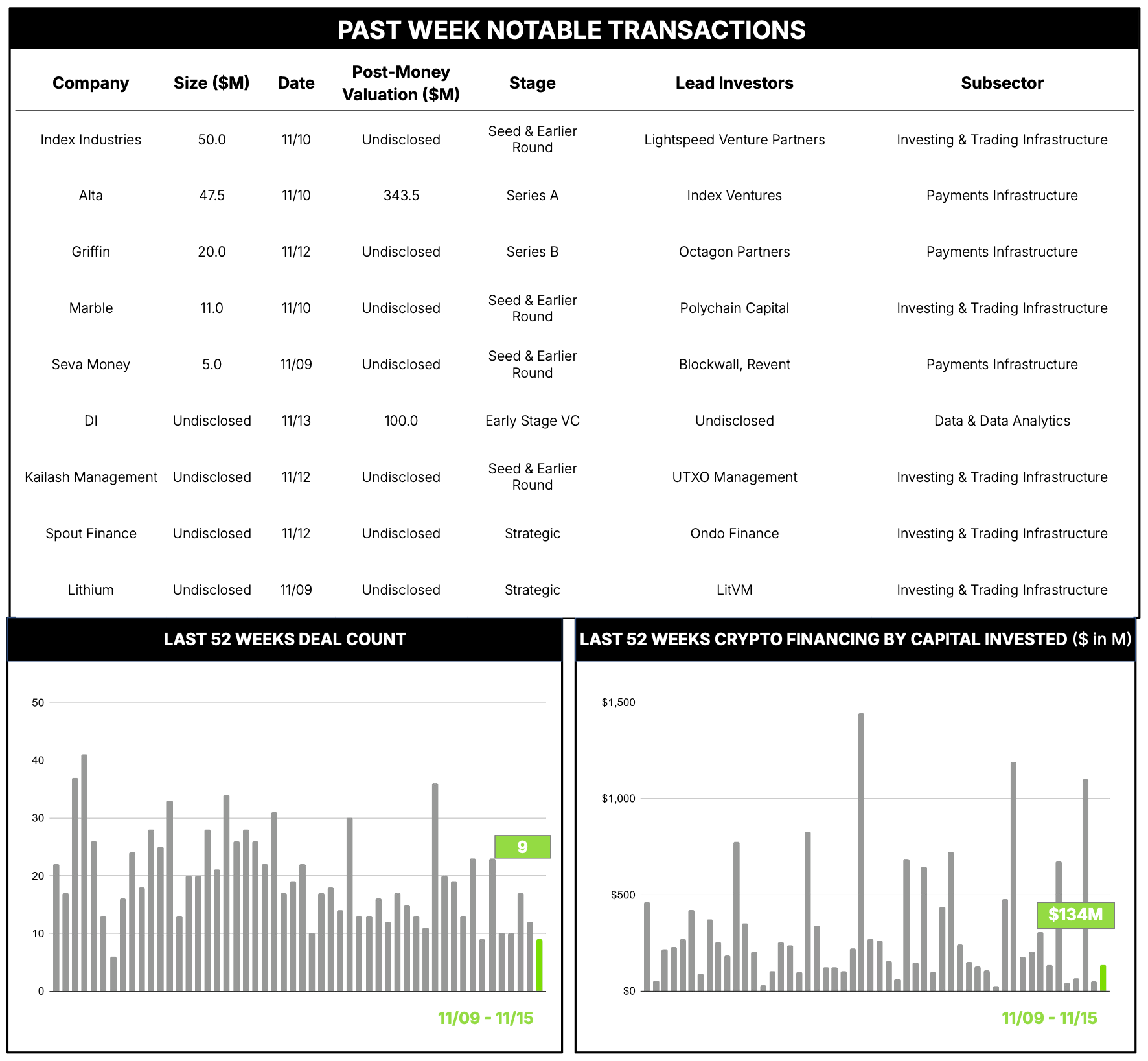
9 Crypto Private Financings Raised: $134M
Rolling 3-Month Average: $379M
Rolling 52-Week Average: $316M
Deals $50M and over: 1
Index Industries has come out of stealth with a $50 million seed round led by Lightspeed Venture Partners, with Polychain Capital, Galaxy Ventures and Wintermute Ventures also participating. CEO Josh Rosenthal is the former president and general partner of Polychain Capital, and chairman Brian Hardecker, who runs residential real estate investor Longmark Group, brings the housing expertise. Lightspeed partner Justin Overdorff said this mix of real estate and tokenization know-how was central to the investment.
The company is building two things. The first is the US Home Price Index, a daily national benchmark that combines established housing indices into one figure. That’s a notable change, since the main housing benchmarks only come out monthly or quarterly. The second is USHP, a token that tracks the index. Holders get exposure to US home prices, a market the company puts at $55 trillion, without having to buy a home. Index Industries runs the index and technology, while a British Virgin Islands company, USHP Limited, issues the token. USHP is set to launch on Ethereum in 2026 and Solana in 2027, for eligible non-US investors only. Demand is building before launch. Solana treasury company Forward Industries has committed up to $50 million to USHP and taken a minority stake in Index Industries, plus warrants for more. USHP Limited says it has up to $100 million in pre-launch commitments, Forward’s included.
Binance’s bStocks, xStocks and Ondo are now the three biggest issuers of tracking tokens for stocks. Other tracking-token issuers have raised this year, including Tenbin Labs and Midas. Tenbin raised $7 million in January, led by Galaxy Ventures with Wintermute, GSR and FalconX, to bring gold and foreign currencies onchain using CME futures. Midas raised a $50 million Series A in March, led by RRE and Creandum. It turns institutional yield strategies into tokens and had issued $1.7 billion in tokenized assets by then.
Parcl is the most direct comparison to USHP because it also tracks home prices. Parcl provides real-time housing market indices and analytics, plus onchain products that let users take long or short positions on home price movements. As with USHP, Parcl users never own a home. They post USDC and take leveraged positions on city indices like Miami Beach or Manhattan. Parcl’s index data is also spreading beyond its own platform. In January 2026, Polymarket and Parcl announced real estate prediction markets that settle against Parcl’s daily home price indices, starting with major US cities. The key difference is that USHP is a simple token that tracks a national index, while Parcl offers city-level leveraged trading.