ARCHITECT SUCCESSES

SEE ALL
Payward Acquires Magic Labs Embedded Wallet Business

Transaction Overview
On July 27, 2026, Payward, the B2B crypto infrastructure parent behind the crypto exchange Kraken, announced a definitive agreement to acquire wallet-as-a-service business Magic Labs. Financial terms of the transaction were not disclosed.

Target: Magic Labs (Wallet Infrastructure)
Founded in 2018 and headquartered in San Francisco, Magic Labs is a wallet-as-a-service infrastructure provider that enables businesses to create non-custodial embedded wallets for their end users. The company was co-founded by Sean Li, Arthur Jen, and Jaemin Jin.

Magic’s core offering is a developer-facing SDK and API that provides embedded wallets with passwordless authentication via email, social login, passkeys, or SSO. The product suite includes 1) API Wallets for server-side management with security and customizable key sharding, and 2) Embedded Wallets for client-side non-custodial key management. As of July 2026, the platform supports more than 30 blockchain networks and provides a white-label UI, fiat onramps, and transaction signing.

As of July 2026, Magic Labs had provisioned more than 60 million wallets and served more than 200,000 developers across more than 18,000 applications. Clients include Polymarket, Naver, Helium, Forbes, WalletConnect, Mattel, and Immutable. During the 2024 U.S. presidential election, Polymarket processed over $3 billion in prediction market transactions with zero downtime, powered by Magic’s embedded wallets. Magic said it had supported over $8.9 billion in cumulative transaction volume for Polymarket as of November 2025.

Magic Labs has raised a total of $83 million in disclosed venture funding across 4 rounds, with significant investors including PayPal Ventures, Northzone, Tiger Global, Digital Currency Group, CoinFund, and Placeholder VC.

In November 2024, Magic Labs announced Newton, a chain unification network built in collaboration with Polygon Labs, expanding beyond wallet infrastructure into cross-chain protocol development. In November 2025, Magic Labs integrated the Newton Protocol SDK across its developer network. The company described Newton Protocol as “the authorization layer for on-chain finance.” These moves preceded the company’s decision to divest its wallet business and refocus entirely on protocol development.

Buyer: Payward
Founded in 2011 and headquartered in San Francisco, Payward is a private B2B crypto infrastructure holding company. Payward operates Kraken, one of the longest-running cryptocurrency exchanges, alongside NinjaTrader, xStocks, Bitnomial, and CF Benchmarks. The company is led by co-CEOs Arjun Sethi and Dave Ripley.

Most relevant to this transaction, Payward operates Payward Services, a B2B infrastructure platform that provides institutions with access to Payward’s trading, custody, settlement, and payments infrastructure via API. The acquisition of Magic Labs adds embedded wallet infrastructure to their offering. In April 2026, Payward launched a white-label fiat-to-crypto onramp through a partnership with Onramper, making embedded wallet infrastructure a natural adjacent capability.

Payward has been expanding beyond its core exchange through acquisition. In 2025, the company acquired NinjaTrader for $1.5 billion (retail futures, M&A Alert) and agreed to acquire Backed Finance (tokenized equities, Press). In 2026, it acquired Magna (token lifecycle management, Press), completed the acquisition of Bitnomial for up to $550 million (regulated derivatives, M&A Alert), and agreed to acquire Reap for $600 million (card issuance and payments, M&A Alert). Including this transaction, Payward has announced or completed 8 acquisitions since early 2025, committing several billion dollars to platform expansion ahead of its planned public listing.

For the full year of 2025, Payward reported adjusted revenue of $2.2 billion, a 33% increase year over year from $1.5 billion in 2024. Trading-based revenue accounted for 47% of the total, with the remaining 53% from asset-based services, including payments, custody, yield, and financing.

In November 2025, Payward raised $800 million at a $20 billion post-money valuation in a round backed by Citadel Securities, Jane Street, and Apollo Global Management, and confidentially filed an S-1 with the SEC ahead of a planned IPO. In April 2026, Deutsche Börse Group made an additional $200 million strategic investment in the company.

Transaction Parameters
Payward has signed a definitive agreement to acquire the wallet-as-a-service business of Magic Labs for an undisclosed amount. The transaction includes Magic Labs’ embedded wallet business, including wallet clients and associated infrastructure.

The transaction is part of a broader corporate restructuring in which Magic Labs is rebranding as Newton Labs to focus on the Newton Protocol. The two companies will remain independent following the close.

Architect Partners served as the exclusive financial advisor to Magic Labs.

Strategic Rationale
Payward is acquiring Magic’s embedded wallet business to augment Payward Services’ B2B offering. Payward Services gives partners a single integration point for trading, custody, tokenized assets, on/off-ramps, and derivatives. The wallet, the account layer where end users actually hold assets and interact with onchain products, was a critical piece partners still had to source from a third party. Magic brings that layer in-house with proven infrastructure: a TEE-based signing solution, an embedded integration layer, and a developer SDK that together have provisioned more than 60 million wallets and supported over $10 billion in stablecoin volume for 200,000+ developers.

On Day 1, Payward can offer fintechs, enterprises, and financial institutions a complete embedded onchain offering under a single provider, spanning wallet provisioning, onboarding, funding, trading, custody, and settlement, without stitching together multiple vendors. Every embedded wallet also becomes a distribution point that routes transaction volume into the rest of Payward’s infrastructure, deepening the non-trading, less volatile revenue that already accounts for 53% of Payward’s total as it heads toward a public listing.

Architect Partners’ Observations
This transaction marks the near-completion of a consolidation wave in embedded wallet infrastructure. In roughly one year, Fireblocks acquired Dynamics ($90M), Consensys acquired Web3Auth ($50M), Stripe acquired Privvy, Ripple acquired Palisade, and Paxos acquired Fordefi. Now each group has its own independent wallet infrastructure provider, and Payward has acquired the category’s pioneer. The market has reached a clear verdict: embedded wallets are foundational infrastructure for every onchain product, and they are a layer of a full-stack platform rather than a standalone business.

The logic is simple: the wallet is becoming the account primitive of onchain finance. Whoever provisions the wallet sits at the front of the customer relationship and routes the volume that follows. For platforms whose trading revenue is inherently cyclical, owning the onboarding layer converts market position into durable, recurring B2B infrastructure revenue.

Sources
Press Release, Payward Services, PitchBook

Insights

Private Financing Snapshot (Week of September 28 – October 4)

Steve Payne and Adlee Heshmat
October 7, 2026
DOWNLOAD FULL REPORT

September 28 – October 4 (Published October 7th)

PERSPECTIVES by Steve Payne and Adlee Heshmat


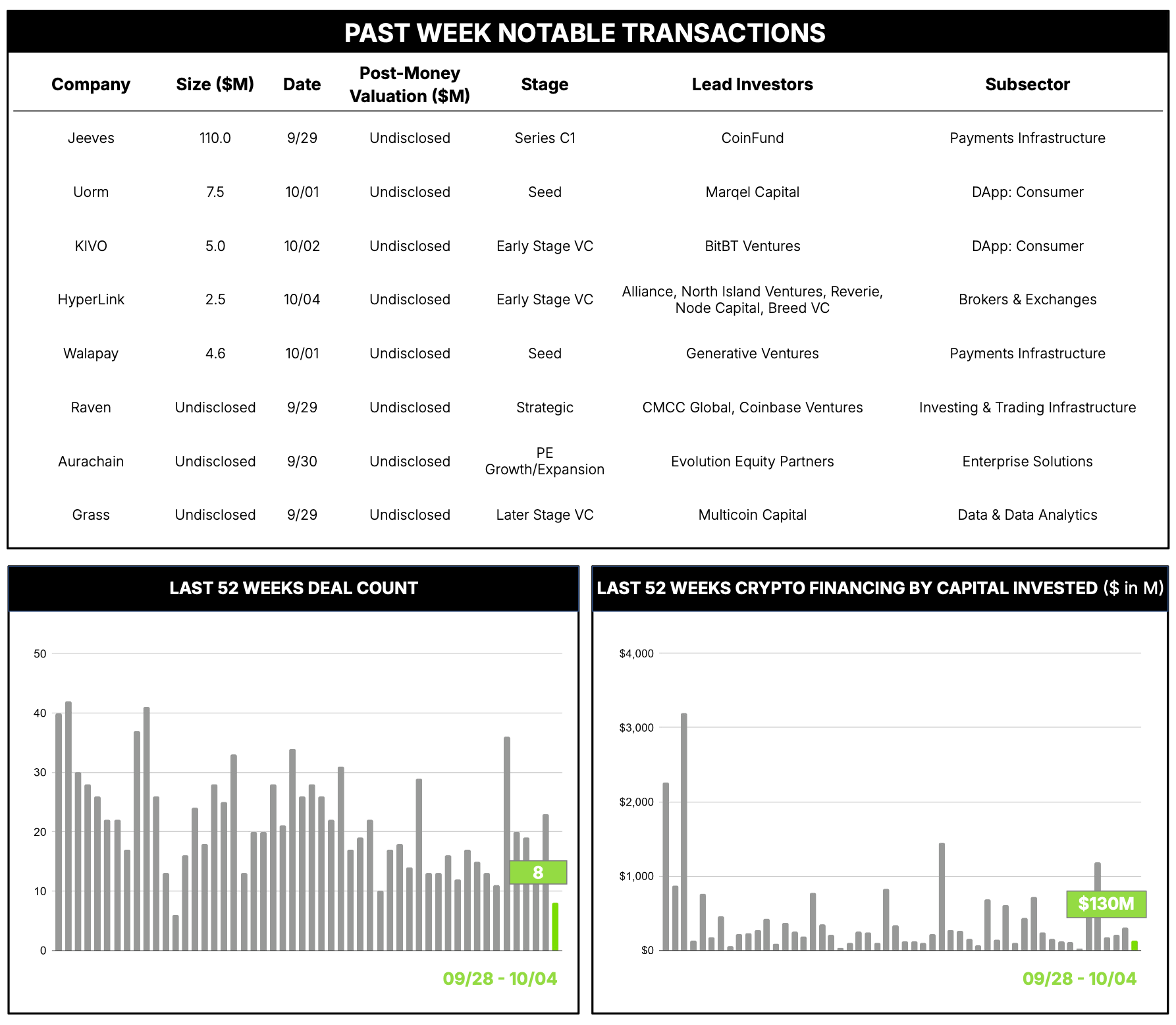
8 Crypto Private Financings Raised: $130M 

Rolling 3-Month Average: $320M 

Rolling 52-Week Average: $418M 

Deals Over $50M: 1


Jeeves announced a $110M round led by CoinFund on September 29. The company reports that revenue grew 4x in 14 months and payment volume tripled over the past year to more than $5B annualized. Stablecoins now account for about $1.5B of that annualized volume, up from almost nothing eight months ago.


Jeeves came out of Y Combinator in 2020 offering corporate cards to Latin American startups. Tencent led its Series C in March 2022 at a $2.1B valuation. At the time, CEO Dileep Thazhmon told The Block he expected Jeeves to have a crypto product within three to four years. The company launched stablecoin payments in September 2025, starting with the Mexico-US corridor.


Jeeves already had customers using its payments products when it added stablecoin settlement. That likely helps explain how quickly the volume grew. By our math, Jeeves processed roughly $1.7B in annualized volume a year ago, suggesting stablecoins account for a little under half of the increase since then.


We’re seeing other payments companies reach substantial volume with stablecoins, including at much earlier funding stages. HIFI, which we covered last week, reports more than $7B in annualized volume at Series A. Walapay, included in this week’s table, reports $2.5B in annualized payment volume at seed.


Payments infrastructure is also taking a larger share of financing activity. Our Q3 2026 Crypto M&A and Financing Report counted 46 rounds raising $896M, compared with 44 rounds and $371M in Q2. The sector accounted for about a fifth of all capital raised during a quarter with the fewest financing rounds since at least 2023. Jeeves was the quarter’s second-largest payments infrastructure raise.


Jeeves did not disclose a valuation. CoinFund calls this a C1 round, coming four and a half years after the Series C. According to Fintech Futures, Thazhmon said revenue grew more than 50% in the few months after signing the term sheet. The company had grown considerably between agreeing to the terms and announcing the round.