June 8 – June 14 (Published June 17th)
PERSPECTIVES by Steve Payne
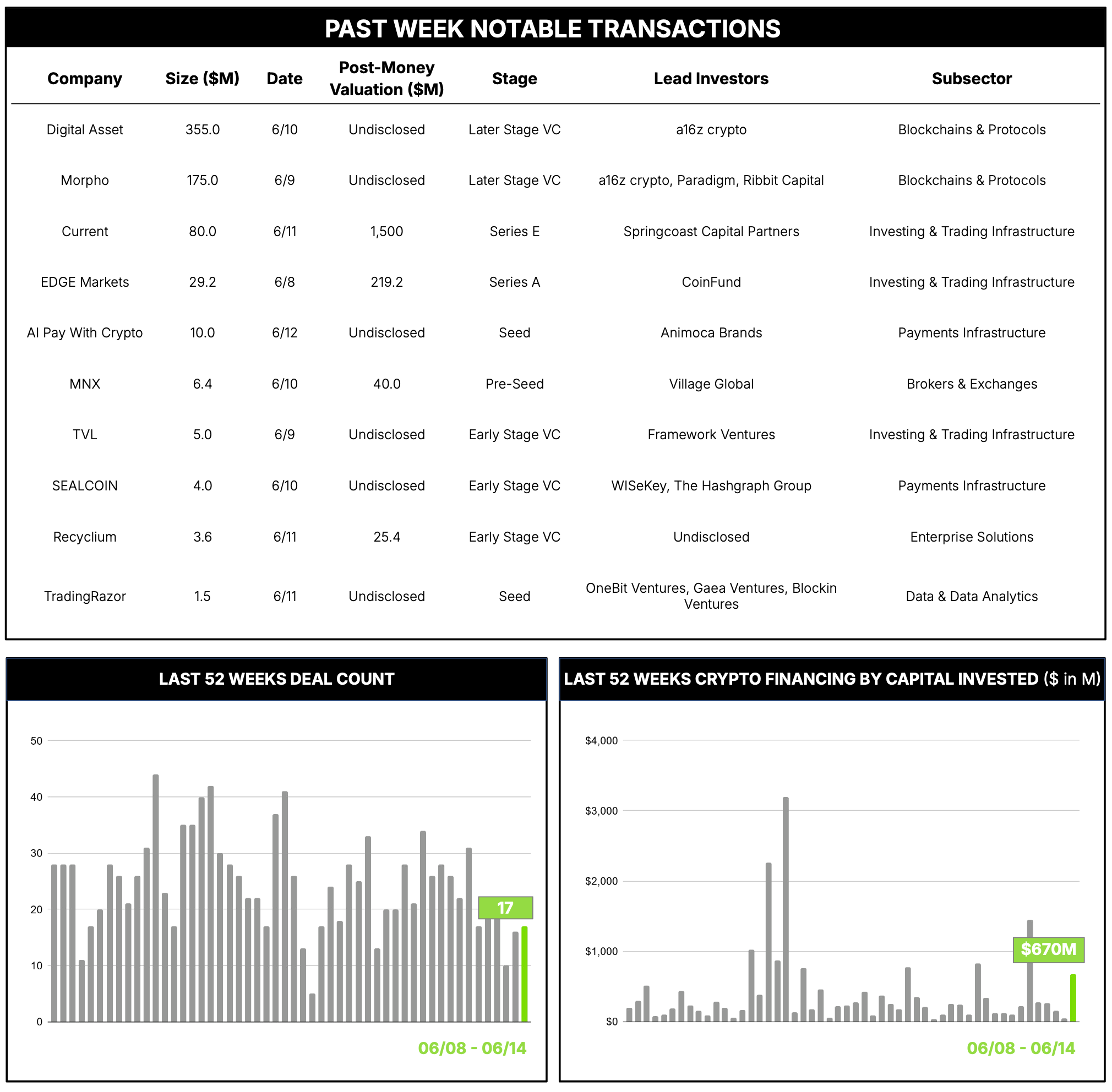
17 Crypto Private Financings Raised: $670M
Rolling 3-Month Average: $381M
Rolling 52-Week Average: $402M
Deals Over $50M: 3
Last month we mentioned that Digital Asset, the creator of the Canton Network, was raising a $300 million round. Last week the company announced it had in fact closed a $355 million round at a reported valuation of approximately $2 billion, with a16z crypto leading and a roster of co-investors that reads like a who’s who of global capital markets: HSBC, BNP Paribas, Apollo, CME Ventures, Citadel Securities, Broadridge, Tradeweb, S&P Global, ADIA, and Coinbase Ventures, among more than 20 participants in total. The round brings a16z into an ongoing partnership role, giving Digital Asset access to the firm’s expertise across company building, policy, and research.
Canton, the company’s flagship product, is a public, privacy-enabled Layer 1 blockchain built for regulated financial workflows; Digital Asset bills it as the only such network with institutional-grade privacy. DefiLlama puts 30-day fee generation at $60.7 million as of mid-June, ahead of both Tron and Ethereum over the same window, and the network reports more than $6 trillion in tokenized issuance to date.
To understand why Canton may be pulling ahead, consider the problem every other approach runs into. Public chains like Ethereum are transparent by design, which is disqualifying for institutions that cannot expose counterparty positions or order flow to competitors on a shared ledger. Private permissioned chains like Corda solved privacy by walling institutions into siloed networks, but then recreated the fragmentation they were meant to fix.
Canton threads the needle through sub-transaction privacy: institutions share the same network and can transact freely, but each party only sees the portions of a transaction it is directly involved in. That architectural novelty explains why the institutional commitments run deeper than the usual pilot-stage “partnership” announcements. DTCC, custodian of over $100 trillion in assets, chose Canton for its Treasury tokenization program. JPMorgan is integrating JPM Coin onto Canton, via its Kinexys unit, for real-time settlement. Visa has joined as a Super Validator. These are infrastructure decisions that, once made, are very hard to rip out, and increasingly, they’re all pointing in the same direction. Note that the investor base is largely the customer base.
Caveat: Canton is not “winning” in any final sense yet. The tokenization market is still early, standards are still being set, and Ethereum’s composability and liquidity advantages are real. But in the specific race to be the default rails for regulated institutional finance (settlement, collateral, tokenized securities), Canton has built a lead. Watch for Hedera, perhaps the most credible challenger in the institutional space. It trails Canton in production deployments, but its cross-ledger interoperability protocol, CLPR, is worth watching closely; if it gains traction, it could become a meaningful differentiator.