ARCHITECT SUCCESSES

SEE ALL
Payward Acquires Magic Labs Embedded Wallet Business

Transaction Overview
On July 27, 2026, Payward, the B2B crypto infrastructure parent behind the crypto exchange Kraken, announced a definitive agreement to acquire wallet-as-a-service business Magic Labs. Financial terms of the transaction were not disclosed.

Target: Magic Labs (Wallet Infrastructure)
Founded in 2018 and headquartered in San Francisco, Magic Labs is a wallet-as-a-service infrastructure provider that enables businesses to create non-custodial embedded wallets for their end users. The company was co-founded by Sean Li, Arthur Jen, and Jaemin Jin.

Magic’s core offering is a developer-facing SDK and API that provides embedded wallets with passwordless authentication via email, social login, passkeys, or SSO. The product suite includes 1) API Wallets for server-side management with security and customizable key sharding, and 2) Embedded Wallets for client-side non-custodial key management. As of July 2026, the platform supports more than 30 blockchain networks and provides a white-label UI, fiat onramps, and transaction signing.

As of July 2026, Magic Labs had provisioned more than 60 million wallets and served more than 200,000 developers across more than 18,000 applications. Clients include Polymarket, Naver, Helium, Forbes, WalletConnect, Mattel, and Immutable. During the 2024 U.S. presidential election, Polymarket processed over $3 billion in prediction market transactions with zero downtime, powered by Magic’s embedded wallets. Magic said it had supported over $8.9 billion in cumulative transaction volume for Polymarket as of November 2025.

Magic Labs has raised a total of $83 million in disclosed venture funding across 4 rounds, with significant investors including PayPal Ventures, Northzone, Tiger Global, Digital Currency Group, CoinFund, and Placeholder VC.

In November 2024, Magic Labs announced Newton, a chain unification network built in collaboration with Polygon Labs, expanding beyond wallet infrastructure into cross-chain protocol development. In November 2025, Magic Labs integrated the Newton Protocol SDK across its developer network. The company described Newton Protocol as “the authorization layer for on-chain finance.” These moves preceded the company’s decision to divest its wallet business and refocus entirely on protocol development.

Buyer: Payward
Founded in 2011 and headquartered in San Francisco, Payward is a private B2B crypto infrastructure holding company. Payward operates Kraken, one of the longest-running cryptocurrency exchanges, alongside NinjaTrader, xStocks, Bitnomial, and CF Benchmarks. The company is led by co-CEOs Arjun Sethi and Dave Ripley.

Most relevant to this transaction, Payward operates Payward Services, a B2B infrastructure platform that provides institutions with access to Payward’s trading, custody, settlement, and payments infrastructure via API. The acquisition of Magic Labs adds embedded wallet infrastructure to their offering. In April 2026, Payward launched a white-label fiat-to-crypto onramp through a partnership with Onramper, making embedded wallet infrastructure a natural adjacent capability.

Payward has been expanding beyond its core exchange through acquisition. In 2025, the company acquired NinjaTrader for $1.5 billion (retail futures, M&A Alert) and agreed to acquire Backed Finance (tokenized equities, Press). In 2026, it acquired Magna (token lifecycle management, Press), completed the acquisition of Bitnomial for up to $550 million (regulated derivatives, M&A Alert), and agreed to acquire Reap for $600 million (card issuance and payments, M&A Alert). Including this transaction, Payward has announced or completed 8 acquisitions since early 2025, committing several billion dollars to platform expansion ahead of its planned public listing.

For the full year of 2025, Payward reported adjusted revenue of $2.2 billion, a 33% increase year over year from $1.5 billion in 2024. Trading-based revenue accounted for 47% of the total, with the remaining 53% from asset-based services, including payments, custody, yield, and financing.

In November 2025, Payward raised $800 million at a $20 billion post-money valuation in a round backed by Citadel Securities, Jane Street, and Apollo Global Management, and confidentially filed an S-1 with the SEC ahead of a planned IPO. In April 2026, Deutsche Börse Group made an additional $200 million strategic investment in the company.

Transaction Parameters
Payward has signed a definitive agreement to acquire the wallet-as-a-service business of Magic Labs for an undisclosed amount. The transaction includes Magic Labs’ embedded wallet business, including wallet clients and associated infrastructure.

The transaction is part of a broader corporate restructuring in which Magic Labs is rebranding as Newton Labs to focus on the Newton Protocol. The two companies will remain independent following the close.

Architect Partners served as the exclusive financial advisor to Magic Labs.

Strategic Rationale
Payward is acquiring Magic’s embedded wallet business to augment Payward Services’ B2B offering. Payward Services gives partners a single integration point for trading, custody, tokenized assets, on/off-ramps, and derivatives. The wallet, the account layer where end users actually hold assets and interact with onchain products, was a critical piece partners still had to source from a third party. Magic brings that layer in-house with proven infrastructure: a TEE-based signing solution, an embedded integration layer, and a developer SDK that together have provisioned more than 60 million wallets and supported over $10 billion in stablecoin volume for 200,000+ developers.

On Day 1, Payward can offer fintechs, enterprises, and financial institutions a complete embedded onchain offering under a single provider, spanning wallet provisioning, onboarding, funding, trading, custody, and settlement, without stitching together multiple vendors. Every embedded wallet also becomes a distribution point that routes transaction volume into the rest of Payward’s infrastructure, deepening the non-trading, less volatile revenue that already accounts for 53% of Payward’s total as it heads toward a public listing.

Architect Partners’ Observations
This transaction marks the near-completion of a consolidation wave in embedded wallet infrastructure. In roughly one year, Fireblocks acquired Dynamics ($90M), Consensys acquired Web3Auth ($50M), Stripe acquired Privvy, Ripple acquired Palisade, and Paxos acquired Fordefi. Now each group has its own independent wallet infrastructure provider, and Payward has acquired the category’s pioneer. The market has reached a clear verdict: embedded wallets are foundational infrastructure for every onchain product, and they are a layer of a full-stack platform rather than a standalone business.

The logic is simple: the wallet is becoming the account primitive of onchain finance. Whoever provisions the wallet sits at the front of the customer relationship and routes the volume that follows. For platforms whose trading revenue is inherently cyclical, owning the onboarding layer converts market position into durable, recurring B2B infrastructure revenue.

Sources
Press Release, Payward Services, PitchBook

Crypto Public Companies Snapshot

Crypto Public Companies Snapshot

Elliot Chun
June 7, 2024
DOWNLOAD FULL REPORT

Scarcity of revenue-mature, reputationally intact crypto companies will drive premium value M&A activity by public companies.


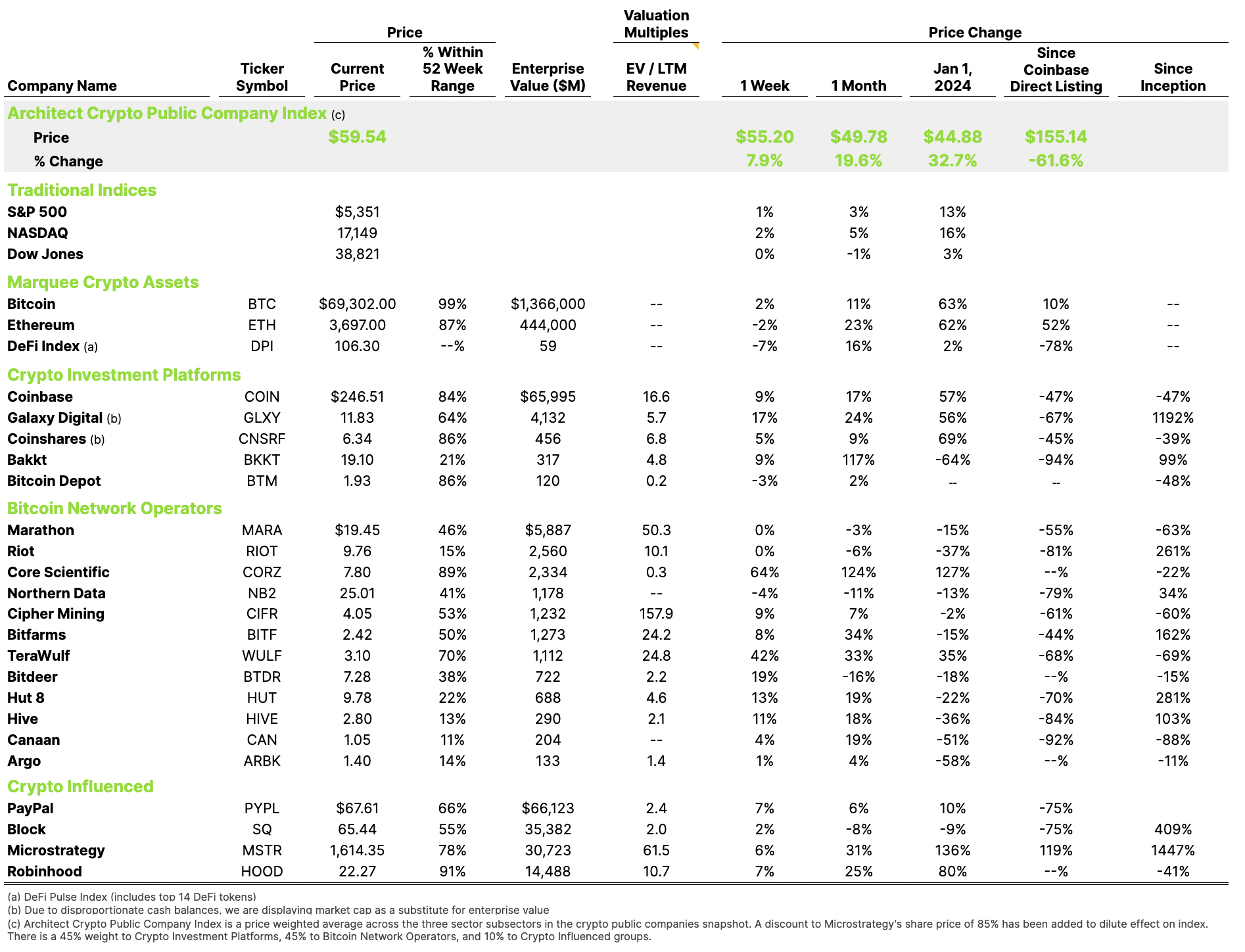
The last two weeks saw meaningful M&A activity for Crypto Public Companies involving 5 out of the 21 components in our Architect Crypto Public Company Index.


  • Robinhood (HOOD) acquired Bitstamp for $200M in cash. This is a significant transaction that we cover in detail in our M&A Alert
    • Bitstamp is one of our global leaders in securing the required regulatory licensing framework in each of their jurisdictions. They have the reputation of doing things the right way and have been doing so for over 10 years. Bitstamp immediately provides Robinhood with a global, regulated crypto footprint where Robinhood can execute their marketing strategies with confidence that they are complying with local market regulations. Bitstamp is one of the few exchanges that can deliver this framework. Crypto still has an adoption problem and the company that made its name by onboarding new users has officially arrived.
      • Robinhood has had an active crypto-related 30 days
      • We previously wrote about the positive shift in regulatory sentiment, but Robinhood announced this acquisition 31 days after receiving the Wells Notice. This is not the behavior of a public company that is intimidated by the SEC.


  • Bitdeer (BTDR) acquired Desiweminer for $140M in equity. The strategic rationale is to vertically integrate and combine ASIC chip design and mining rig manufacturing with data center hosting and BTC mining. Bitdeer is the first publicly traded company to execute on this vertically integrated strategy.


  • Riot (RIOT) proposed an acquisition of Bitfarms (BITF) at $2.30 per share representing $950M in total equity value with the intention of becoming the world’s largest publicly listed BTC miner. That proposal was rejected by Bitfarms, who is actively reviewing other strategic alternatives. Post-Fourth Halving M&A activity will continue to accelerate as the effects of the reduced BTC rewards set in and separates the quality operations from the non-quality ones.


  • CoreWeave – a privately held, cloud AI company who raised $1.1B at a $19B valuation in May and has near-term IPO aspirations – made an all-cash offer to acquire Core Scientific (CORZ) for ~$1B in value. That proposal was rejected by Core Scientific, who was in a bankruptcy process in Dec 2022 – a remarkable turnaround. CoreWeave and Core Scientific also announced a 200MW hosting contract this week. The strategic rationale is to combine AI compute with BTC compute and we expect this strategy is only just starting.  


A critical theme for our industry is scarcity as there are not a lot of revenue-mature, reputationally-intact crypto companies. 


As public companies seek to execute their blockchain and crypto strategies via acquisition, there are less than 100 crypto companies that would meet acquirer requirements. If you categorize these companies within specific subsectors, products or services, each category only has about 3 – 5 companies who have meaningful businesses that can move the needle for acquiring organizations.


Robinhood’s acquisition of Bitstamp takes one of the top 25 exchanges off the table. Looking deeper at what differentiated Bitstamp, they were arguably the only exchange with as robust of a global licensing footprint. How many other Bitstamp-like exchanges exist? Less than 10. 


There are 12 U.S. publicly listed BTC miners with over $100M in enterprise value and 33% of them had some M&A activity this week. I expect all 12 will have some corporate action by the end of the year.


I also expect a Dow Jones component-like public company will acquire a crypto subsector leader by the end of the year which will catalyze a flurry of M&A activity. Once the best companies are taken, there is a significant drop to the next tier.


Maybe that transaction occurred this week.


The entire Architect Partners descended on Consensus in Austin last week. This week, we participated in NY Tech Week. Some observations:


  • The uncontrollable political environment is just something our industry has to deal with. We don’t need a positive environment and we’ll take anything better than hostile. And yes, Crypto will play a role in the outcome of U.S. Elections.


  • The next downward cycle will begin in 12 months to 18 months. Most expect a downward trend to start during Consensus next year. I’m more in the 18 – 24 month camp and don’t think it will be as severe as previous cycles, unless it’s Liquid Restaking-related. Then it will be severe.


  • Bull case BTC is $1.5M by 2030.


  • There is still too much noise at these events, especially with MemeCoins taking things to ridiculous levels, but it’s not as much in previous cycles.


  • The institutions are all attending. Every one of them has a presence at these events. They are just difficult to find (on purpose).


  • Our industry has become really efficient at conferencing. I was at 76 events & meetings over 4 days. Yes that includes Dueling Pianos and does not include my 3 mechanical bull rides.


  • The worst thing I heard someone say was “LRT BTC L2”. 


  • The who at these events is the best part of this industry. We surround ourselves with passionate innovators, investors and service providers who exude humbleness to know we don’t know anywhere close to everything; curiosity & bravery to constantly learn and understand (and fail) in real time; intelligence to actually comprehend and apply what we learn; grit, resolve & belief to survive through the constant cycles; a somewhat sadistic sense of humor to enjoy what we do and who we do it with; and an unwavering moral & ethical compass. We are on the right side of history.